







Justice and Reality: Think Like a Lawyer

Hello, I’m Zhan Qingyun.
Recent cases have been heartbreaking: thirty-nine bodies found in a truck container in Britain, and the same day an eleven-year-old girl killed in Dalian, allegedly by a thirteen-year-old boy.
Neither investigation was final when I recorded this, so judging the facts would be improper. But both prompted legal debate.
If the thirteen-year-old is confirmed as the Dalian killer, current Chinese criminal law imposes no criminal responsibility because he was under fourteen.
Many find that intolerable because the victim was also a minor whose rights seem ignored.
Every serious offense by a young child renews debate over whether an age line should exist and where it belongs.
Law creates special rules for groups such as minors and people with mental disabilities; some countries also treat older adults specially.
I planned to discuss these exceptions near the program’s end. This case offers a timely chance to examine the history, principles, and future of special juvenile protection and punishment.
China’s Current Age of Criminal Responsibility
Under fourteen, there is no criminal responsibility; fourteen to sixteen brings limited responsibility; from sixteen, full responsibility.
Critics note that this scheme dates from the 1970s and argue that fifty years of social and developmental change make fourteen obsolete.
The line is old. Indeed, modern Chinese legal history repeatedly raised, rather than lowered, the age.
In 1951 the central legal commission proposed no punishment below twelve. The 1954 Reform Through Labor Regulations placed offenders aged thirteen to under eighteen in juvenile institutions, effectively setting thirteen. A 1957 criminal-law draft adopted thirteen; a 1963 draft raised it to fourteen. The 1979 Criminal Law formally established fourteen, retained in 1997 and today.
Thus the 1950s–70s raised the threshold; decades later, heinous crimes prompt demands to lower it.
For international comparison, The Economist published a clear global chart in 2017.
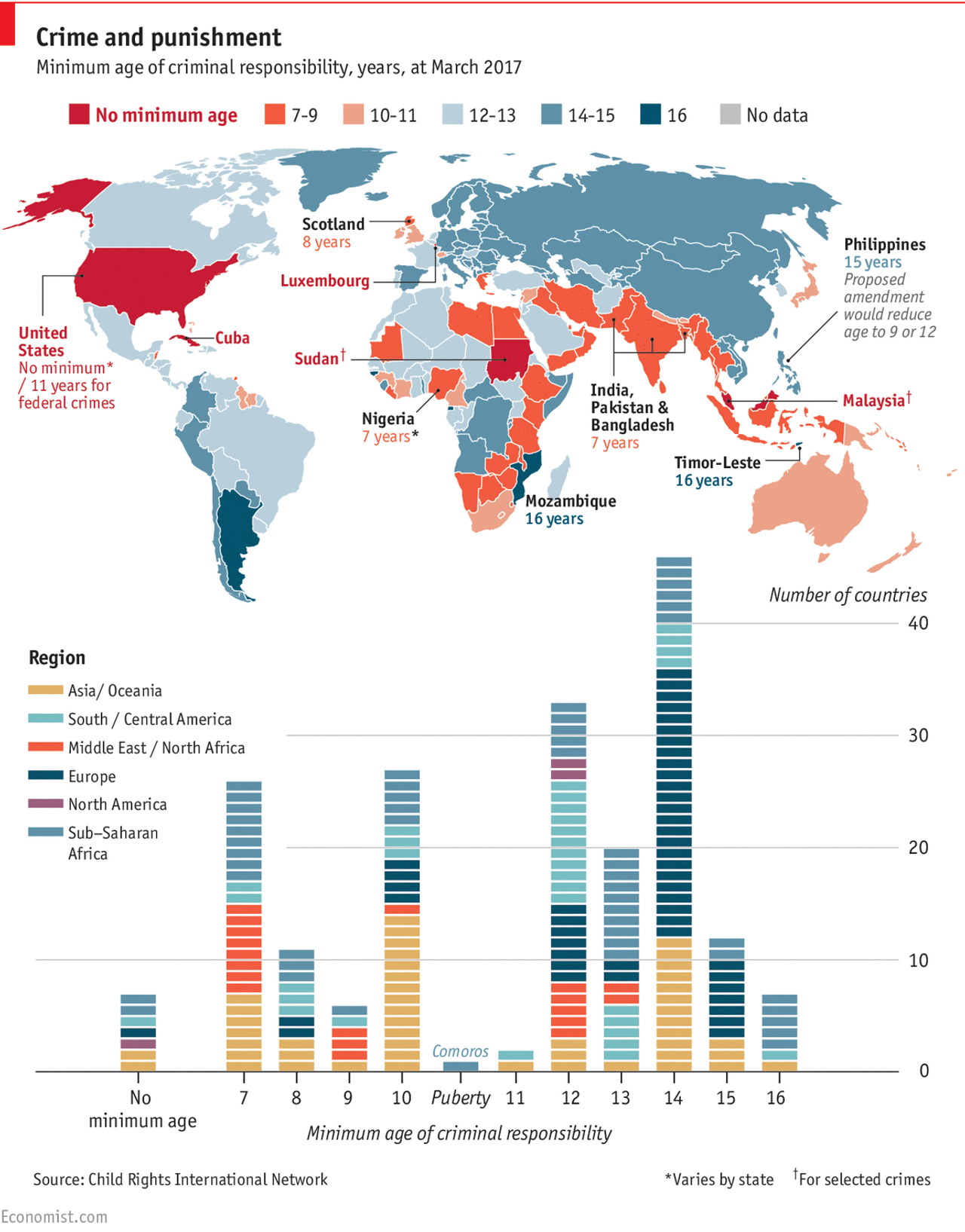
Minimum Ages of Criminal Responsibility Worldwide
The March 15, 2017 chart followed Philippine president Rodrigo Duterte’s drug war and plan to lower his country’s age from fifteen—already high—to nine or lower, provoking international controversy.
The Economist noted ironically that while observers watched the Philippines, thirty-five US states had no minimum at all: children of any age could theoretically be convicted and sentenced.
America and the Philippines were outliers. About forty-five countries, including China, used fourteen; most imposed some limit, while the US aligned unusually with a small group of states it often criticized.
Besides the US, only Cuba, Iran, Sudan, and Malaysia lacked a minimum, and then only for specified crimes.
Over forty countries used fourteen, nearly one hundred used twelve or thirteen, and most of the world therefore fell between twelve and fourteen. More than twenty used seven and more than twenty used ten.
China sits toward the higher side but within common international practice; fewer than twenty countries use fifteen or sixteen.
Special legal treatment for young children has an ancient Chinese tradition.
Historical ‘Special Care’ for Juvenile Offenders
Over two millennia ago, the Rites of Zhou said people over eighty and children under seven were not punished even if guilty, and children who had not shed their milk teeth could not be enslaved for crime—roughly below eight for boys and seven for girls.
From the Warring States through Han, Tang, Northern and Southern Dynasties, and Ming law, children under seven or eight were commonly exempt even for capital offenses, while those under about fifteen received mitigation.
Influenced by Western reform, the late Qing New Criminal Code declared conduct below sixteen noncriminal but permitted rehabilitative education—a contemporary choice combining exemption with corrective custody.
The Republic of China likewise exempted those under fourteen and allowed reduced sentences from fourteen to eighteen. A boundary between minors and adults, with exemption or mitigation below it, is ancient and continuous.
Similar traditions existed throughout the West and human societies generally.
The Roman Twelve Tables, from the fifth century BCE, prescribed death for an adult who cut or trampled crops at night, but whipping or double compensation for a minor at the praetor’s discretion.
The underlying death penalty for damaging crops was itself terrifying.
Still, adult and juvenile punishment clearly differed. Justinian’s Code first articulated that children could not premeditate crime: no child was innately bad and every child could be saved. That principle still grounds juvenile justice and child-protection provisions.
The 534 code also emphasized discipline and set responsibility at fourteen for boys and twelve for girls—an ancient recognition, or discrimination, concerning different maturation ages.
Modern theory favoring separate treatment arose in the nineteenth century, amid Darwinism and a major change in ideas about punishment’s purpose.
The Nineteenth-Century Criminal-Law Reform Movement
Early punishment was retributive—evil repaid, eye for eye. Nineteenth-century social-defense theory instead stressed preventing crime.
Positivist criminology or criminal anthropology then used natural-science methods to study psychological, physiological, and social causes. Its research proposed new juvenile policies and inspired institutional experiments.
It argued offenders were shaped by environment and deficits rather than innately evil, with juveniles especially dependent on social context. Since the goal was a better society, policy should seek effective measures beyond revenge.
Research also found juvenile and adult crime arose from different causes and required different responses tailored to the young offender. These theoretical, social-scientific, and methodological changes converged in criminal-law reform.
One major outcome was explicit statutory age boundaries.
France’s 1810 Penal Code exempted felony defendants under fifteen, placing them with family or in correctional institutions; discerning minors could be sentenced, but less severely than adults. The approach spread through Western Europe, Germany, modernizing Japan, and by the turn of the century to colonies in South and Southeast Asia.
Western countries also created separate juvenile institutions. They sheltered homeless and poor children with schooling and skills to prevent crime, and provided correctional upbringing for those who had offended.
Britain developed the Borstal system, a milestone widely imitated. Offenders aged fifteen to twenty-one deemed to need confinement were separated from adult criminals to avoid deeper entry into criminal culture.
Under strict discipline, Borstals taught industrial work and production skills—both custodial institutions and labor education—isolating youths from harmful adult influence while preparing them for lawful employment and life.
The system proved successful for British society and spread rapidly through Europe and Asia.
Another decisive invention came in Illinois in 1899: the world’s first Juvenile Court Act and first juvenile court, a special tribunal applying a code adapted to minors and affording them protection.
2019.10.29
Audio in Chinese
Related programs

Young Idealists
Twenty conversations between young editors and senior thinkers
Free

When You Are Old: 30 Lectures on the Psychology of Aging
We will all grow old
¥98.00
Included with membership

Revelations of Childhood: 30 Lectures on Child and Adolescent Development
Understand children—and the road that made us
¥98.00
Included with membership


