




To Your Unique Self: 40 Lessons in Personality Psychology

Introduction
Hello, I’m Wang Fang. Welcome to To the Unique You: 40 Lectures on Personality Psychology.
As someone who studies, teaches, and researches psychology, over the past twenty-odd years I have repeatedly been asked what psychology ultimately means to me, or what my greatest gain from studying it has been. Questions like these are of course difficult to answer in one or two sentences. But if I were to answer, one thing would certainly be included:seeing the uniqueness of every individual and respecting every unique person. That is why this program is called “To the Unique You.”
How would you describe yourself? Have you ever wondered what made you who you are today? And what forces are pushing the person you are at this very moment toward a continually renewed self?By coincidence, these three questions correspond to philosophy’s three ultimate questions:Who am I? Where did I come from? Where am I going?
Ever since humanity traveled the long road of evolution and finally developed self-awareness, these questions have been asked in anguish through countless dark nights, and people have spent entire lives searching for answers. Since the birth of modern psychological science, especially personality psychology, we may have gained a perspective from which to begin with an understanding of ourselves and the forces that shape us, and gradually seek and approach the answers that belong to our own lives.

Who Am I?—Starting with a Name
Who am I? When asked this question, most people may instinctively give their name. For example, I am Wang Fang. Wang Fang is the single most common name among Chinese women. There are roughly 270,000 people named Wang Fang in China; if they were gathered together, they could probably form a county called Wang Fang County.
Does your name have a special meaning? Mine does. My mother chose it. In 1964, before the era of what we now call blockbusters, a film called Heroic Sons and Daughters became enormously popular. It tells a story from the War to Resist US Aggression and Aid Korea. If you have seen Zhang Yimou’s film One Second, Heroic Sons and Daughters is the movie that keeps playing in it. Its protagonists are a brother and sister. The younger sister is named Wang Fang: a beautiful, kind girl who sings well and grows into a strong woman soldier amid the trials of war.
I can imagine the indelible impression this film left on my mother during the crucial period when her values were taking shape in her teens. So when she had a child, she naturally projected some of her youthful feelings onto me. Does this pattern continue today? Whenever an idol drama becomes a sensation, it probably inspires a wave of babies, born that year or in the years after, who are given the hero’s or heroine’s name.
Can a name really define a person in some sense, or even influence their later development? That sounds rather dubious, and mystical theories about naming are certainly not credible. From a psychological perspective, however, names do carry rich meanings—
First, a name usually contains the earnest hopes and blessings of the person who chose it, generally the parents. Guided by those expectations, parents may then raise the child in ways that encourage the corresponding direction of development. Sometimes people around us also form expectations based on a name: someone called Grace is expected to be graceful, while a child named Jingjing—literally “quiet”—is presumably not meant to be noisy.Whether or not those expectations are reasonable, children may internalize them to some degree and even genuinely develop in the corresponding direction, ultimately making the expectations come true without realizing it, creating the appearance of a connection between the name and the person who bears it.
The meaning of a name goes much further. To attack the human side of a person, one first deprives them of their name and replaces it with an objectifying code; this is the first step in dehumanization. Once a person is imprisoned, for example, their name may be replaced by a string of numbers, signifying that they are no longer treated as a whole human being. This reminds me of the film Persian Lessons. To survive in a Nazi concentration camp, the protagonist falsely claims that he speaks Persian and invents a fake Persian language from the camp’s list of prisoners. The more than two thousand names he consequently remembers become evidence that those lost lives once existed in this world. Conversely, the first step in forming an emotional bond with a nonhuman object or animal is to give it a name—think of the little pig named Peppa whom everyone loves. There are many more examples: in Your Name, writing one’s name in a lover’s palm ensures one will never be forgotten; in Spirited Away, recovering one’s name is necessary to recover one’s true self; and Call Me by Your Name is filled with an affection beyond words.
A name therefore has powerful psychological significance. As the first social label in life, it distinguishes us from others, marks where we come from and where we grew up, and carries emotions, memories, and identity. It can even serve as a cornerstone for connecting with others and proving our existence in the world. Perhaps our names deserve some credit for who we have become.
Yet I believe those 270,000 Wang Fangs are still all different. Parents’ expectations may be beautiful, but development is relatively objective and cannot be entirely redirected by subjective will. My parents wanted to cultivate me in the direction of a heroine, for instance, but the internal and external conditions apparently did not permit it, so that effort quite obviously failed completely. As we move further along in life,a person’s growth inevitably leaves the parents’ field of view and is shaped by personal experience.
In my own experience, what I studied, the people I met, and the things that happened during university have so far influenced me most. Looking back, my connection with psychology feels rather miraculous and was actually accidental. I entered the Department of Psychology at Beijing Normal University as an undergraduate in 1996. I had been recommended for admission and could choose between chemistry and psychology. I knew nothing about psychology then; I simply used elimination to avoid a major that did not interest me much, and thus arrived in psychology. For that very reason, my initial learning experience was hardly enjoyable. At graduation I even wondered, “What did I learn in these four years?” Fortunately, despite all the stumbling, I have continued down this road to the present.
Last year, 2020, held special meaning for me because it marked the twentieth anniversary of my university graduation. Because of the pandemic, our class reunion took place online. To accommodate classmates in overseas time zones, we began at eight in the morning and continued into the afternoon. Mention a middle-aged class reunion and one may imagine the scene easily turning dramatic—people showing off, competing in secret, exchanging business flattery, or making painfully awkward small talk. None of that happened that day. Everyone simply looked back with great sincerity on the twenty years since leaving school: the events they had experienced, what they had gained, their present confusion, their hopes for the future, and all the subtle flavors of life.
Measured by the conventional standard of “success,” regrettably, no one in our class holds very high office or possesses immense wealth. As people who studied psychology, we encounter midlife crises too. Studying economics does not necessarily make you better at stock trading; studying computer science does not necessarily make you better at repairing computers; and studying psychology does not necessarily make you happier. A discipline does not hand you the finished outcome or product. What it can provide are methods and perspectives for seeing, thinking about, and solving problems.
Yet even those classmates now working outside psychology can clearly feel that studying it has exerted a positive—and significant—influence on their lives. It has helped themview the world more rationally, treat others more calmly, and face themselves more honestly; their interpersonal, intimate, and parent-child relationships have all benefited greatly. In other words, time does not spare you even a fraction of its challenges because you studied psychology. But under the tests of time, my dear classmates have become rich and warm human beings.
For me personally, after twenty years psychology has changed from my major into my profession. More importantly, it continues to nourish me every day. It is no exaggeration to say that psychology forms the foundation of my inner world. Sometimes I think that in another parallel world there is a Wang Fang who chose chemistry; she would probably be doing well too. But I can no longer imagine what it would be like to see the world with a mind that psychology had never transformed. I hope to pass on through this program the psychological forces that have continually nourished me.
Beyond names and experiences, and on a broader scale, “who I am” is also defined by the era and social environment in which we live. We live in this era—not antiquity, and not more than a century ago. Supposethe era were different and society were different: would we still become who we are?Or put it another way: imagine two babies, one born in the Tang dynasty in the ninth century and the other in the twenty-first century today. They might not differ greatly at birth, yet they could become very different people as adults. In other words,our wider environment and historical context shape, to a considerable degree, how we interact, think, express ourselves, and live—and what kind of people we become.
In this way, parental heredity and child-rearing behind our names, the people we encounter and the knowledge we acquire through personal experience, and the historical background, culture, and cultural changes around us all converge and blend imperceptibly, ultimately shaping every one of us into a unique individual. This psychological part that differs from everyone else is the subject of our program:personality.。
What Is Personality?
What kind of person am I? How am I different from others? What effect and meaning do these differences have for me and my life?I imagine every ordinary person wants answers. Personality psychology is the scientific study that investigates them. Put simply, it studies individual differences in thought, emotion, and behavior, and how those differences exist together as an integrated whole within each individual.
So what is personality?We often say that humans are the most intelligent of all beings. Every individual resembles a small god in nature, possessing an independent inner world, capable of complex thought, rich emotion, and endlessly varied action. Most remarkably, all these things can occur coherently within one person, allowing you to know clearly: this is you, this is me, this is them.Psychology calls everything that clearly identifies one person, distinguishes that person from another, and makes us who we are “personality,”or, in more everyday language, “individuality” or “character.”
In English,the word “personality” derives from the Latin persona, meaning a mask—the mask worn by an actor onstage. In the dramaturgical view, all the world is a stage and all men and women are actors: we live upon the stage and perform in life. Life is like a play and depends upon our acting. We may not have received a script, but we all have a persona, and that persona can in some sense be called personality. With the mask of personality, the audience below and our fellow actors onstage can understand what kind of person we are and predict our future behavior.
In more academic terms,personality is the relatively stable and enduring pattern of an individual’s behavior, cognition, and emotion that evolves from biological and environmental factors.
The most important feature of personality isuniqueness. “People’s minds differ just as their faces do.” No two people are entirely alike. Each of us has our own way of thinking and logic of action, our own hidden sore spots and little prides unknown to others. These make each of us a one-of-a-kind self. Our program will unfold around this unique self and guide you toward an understanding of personality.
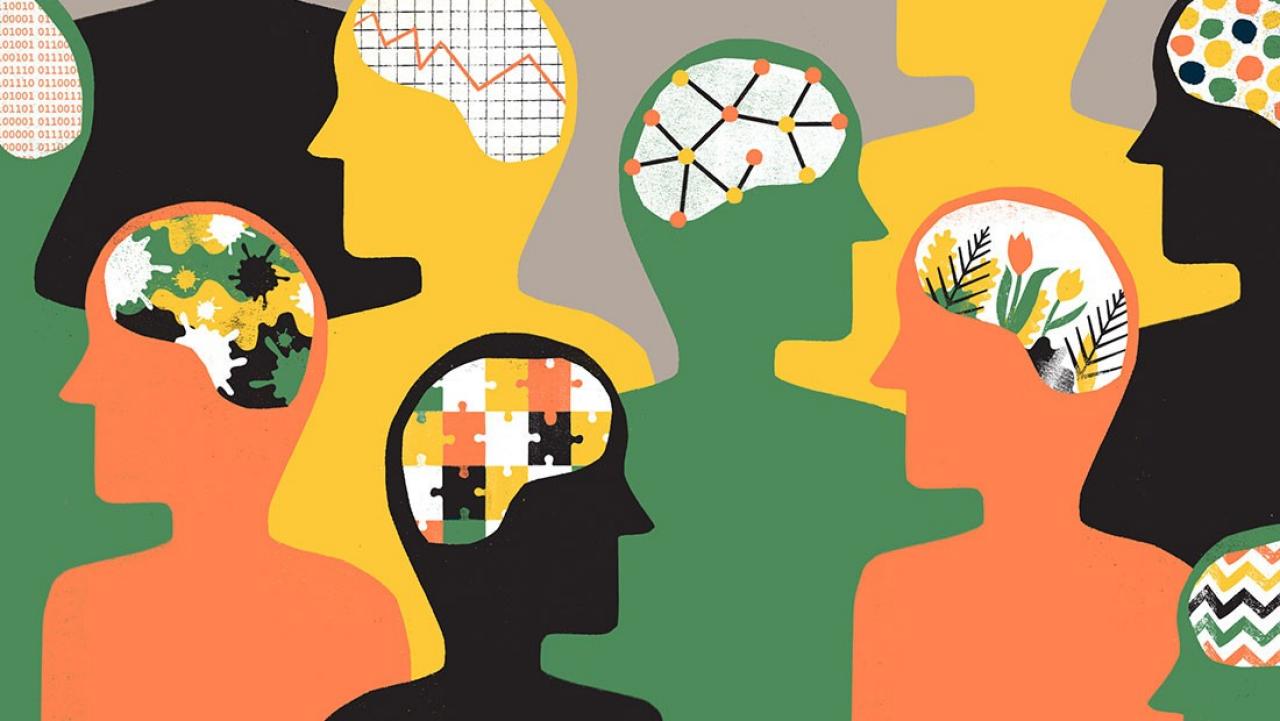
First, exactly where does the uniqueness of the “unique you” lie? People differ from one another, butin what respects do those differences appear, and how should we identify and describe them?This is the first part we will cover, and to some extent it answers the question “Who am I?” With personality traits at the center, we will begin with some currently popular so-called “personality tests,” then introduce more scientific models and tools for describing personality.
The second part may correspond in some measure to the question “Where did I come from?” It examines why we became who we are today—in other words,how personality is formed. Following the two major paths for explaining human nature—the biological and the sociological—we will introduce the key factors that shape personality at different levels.
The final part attempts to respond to “Where am I going?” by examiningthe motivations behind personality. Here we will survey representative figures and theories in personality psychology and see how they understand personality and human nature through motivation. We will discuss such brilliant names as Freud, Jung, Adler, Maslow, and Rogers. Guided by the extraordinary insights of these psychological masters, you will see that human beings possess fundamental desires and irrational needs, as well as higher hopes and pursuits that distinguish us from animals.
I would also like to explain that theory and research will form the framework of this program.Although “personality” can neither be seen nor touched, it is expressed in our thoughts, ideas, and behavior. By examining this directly observable information, psychologists can define and describe personality-related characteristics and even measure them systematically. Psychologists are also skilled at using experiments to explain the causes behind behavior. They propose hypotheses about experimental results, test their validity through precise measurement and controlled observation, and summarize the results into theories that predict future observations—while continually revising existing theories in light of newly collected data.
In research, psychologists draw on many tools, including psychological tests, and use specialized instruments such as devices that record brain activity. Such methods have been widely applied since the rise of cognitive neuroscience, enabling us, to some degree, toglimpse the physiological basis of personality’s “black box.”。
Of course, although all mental activity is a function of the brain, psychology did not rename itself “brainology.” It has retained the idea of the psyche or mind, representing the discipline’s concern with the essence of human nature. Beyond these distinctive methods, personality psychology draws on rich intellectual sources, absorbing knowledge and experience from philosophy, anthropology, sociology, biology, and other fields. You will see how personality psychologists apply this diverse knowledge to understanding the individual mind.
Conclusion
I like the name of this program very much—To the Unique You.Admittedly, each individual is infinitesimal in relation to the universe and no more than a speck of dust in history. Yet within the one life we receive, every one of us is unique and cannot be replicated. The miracle of life lies in the fact that it is ordinary, and yet it is a miracle. Within that miracle, the questions arising around each individual “I” constitute the many research topics of personality psychology.This program may not touch on everything, nor will it necessarily provide perfect answers. But I look forward to sharing with you one aspect of psychology, a discipline still in its youth. Many people first encounter psychology through practices such as counseling and see it as a tool for solving problems,but theoretical and research psychology is just as inseparable from life. It can and should become a general way of thinking and even a way of living: a perspective from which to view problems, and one option through which we think about and understand ourselves and the world.
Of course, as I said earlier, studying psychology does not necessarily make a person happier, and the same is true of this program. What I discuss may not bring you immediate change or produce any quantifiable outcome; it will not make anyone more beautiful, slimmer, or more stylish. We will even discuss seemingly grand and impractical topics such as “meaning.” But if you are willing to keep listening, I think you may discover, as I did, that the most fascinating and rewarding part of studying psychology isrecognizing differences among people and then accepting, accommodating, and respecting those individual differences.To me, this is also the warmest and most romantic aspect of psychology:it sees every person. It takes a lively interest in understanding ordinary people’s joys and sorrows, their love and grief, and it cares for and respects every life that is ordinary yet unique.I hope that every unique one of you will gain something from this program.
So let us begin now. See you in Lecture One!
2021.11.11
Audio in Chinese
Related programs

When You Are Old: 30 Lectures on the Psychology of Aging
We will all grow old
¥98.00
Included with membership

One More Lesson
What school didn't teach, learn for yourself
Free

Revelations of Childhood: 30 Lectures on Child and Adolescent Development
Understand children—and the road that made us
¥98.00
Included with membership