







To Your Unique Self: 40 Lessons in Personality Psychology

How Social Ecology Influences Personality
Hello, I’m Wang Fang. A confession: I am a fan of the band Omnipotent Youth Society. Today’s title comes from a famous lyric in their song The Heart-Wrenching Joke and the Long Daydream: “Who came from mountains, rivers, lakes, and seas, yet is confined by day and night, the kitchen, and love?” Every time I hear it, I feel freedom and openness.
If day and night, kitchen, and love represent time, daily life, and emotion, then beyond these trivial routines lie vast mountains, rivers, lakes, and seas. My professional instincts connect this to psychology. Mainstream psychology and popular understanding are usually restricted to individuals and what occurs inside them. We constantly examine events within an isolated brain: an action, a thought, an emotion, then another emotion produced by the first. That is,our focus remains everyday behavior and feeling and other everyday behavior and feeling that influence them.It is as though we live inside a self-created bubble where we are both influencer and influenced, neglecting the world outside. The perspective is too small. Some researchers therefore look beyond intimate days, kitchens, and love to broad mountains, rivers, lakes, and seas.
For personality, traditional psychology emphasizes proximal environments such as heredity, physiology, family, and school. Yet people think, feel, and act within political, economic, religious, climatic, and geographical contexts (Oishi & Graham, 2010). A research approach calledsocioecological psychologyassumes that these distant, macro-level, objective factors also shape personality (Oishi, 2014). Specifically,a social ecology defines the adaptive tasks people must complete, and personality may be the collection of behaviors used to address and solve those tasks(Sng et al., 2018). Realities outside the mind directly influence psychology and behavior and may form clusteredpersonalities of an eraorgroup personalities.”。
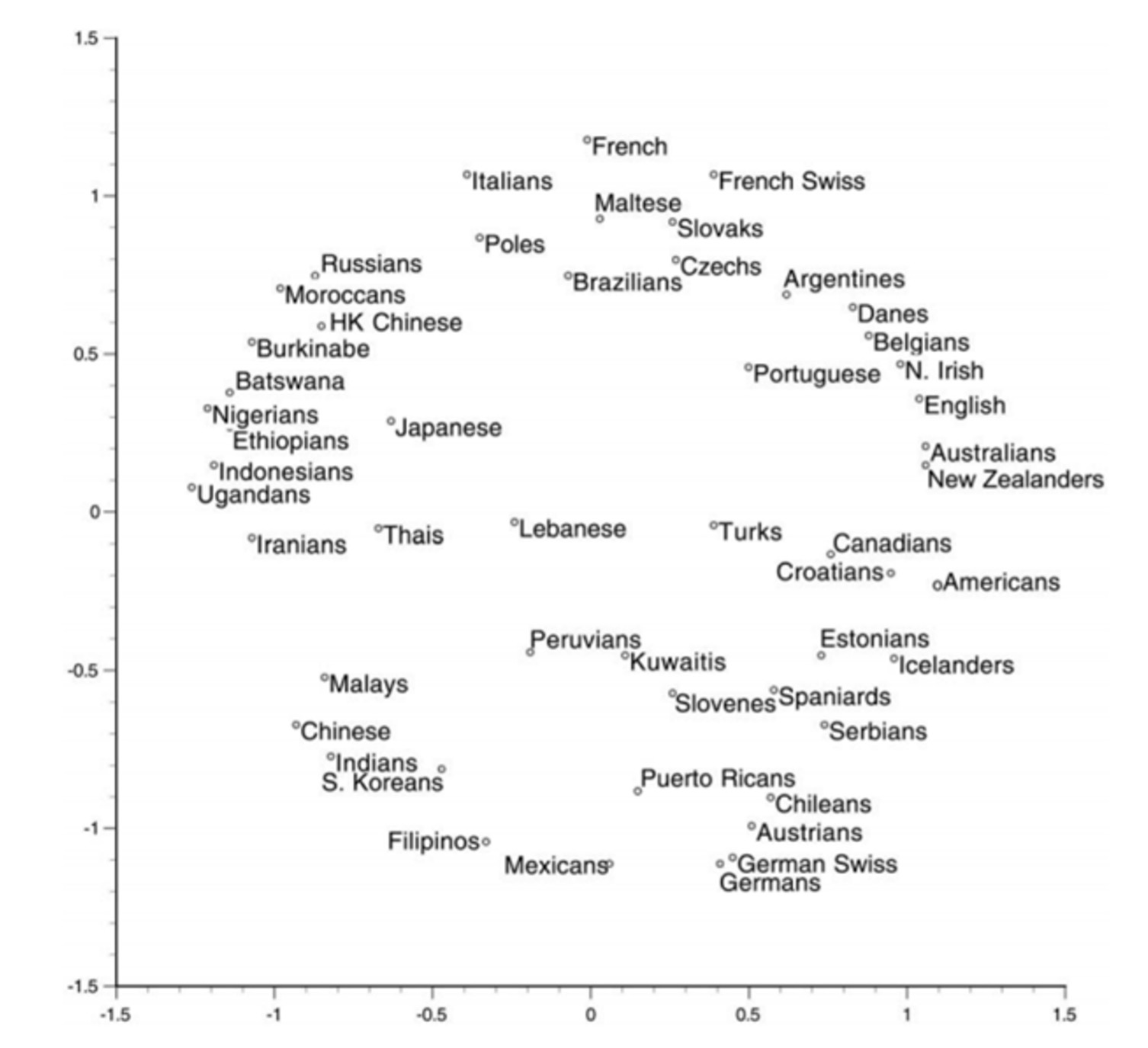
We observe systematic personality differences across periods, countries, and regions, with particular personalities clustering in particular times and social contexts. In 2005, a large study compared Big Five traits in fifty-one countries. Mainland China appears near the lower-left of the transcript graph: relatively introverted and low in neuroticism overall (McCrae & Terracciano, 2005).
2022.01.25
Audio in Chinese
Related programs

Inequality: Power, Status, and Social Distribution
Why does equality recede the harder we pursue it?
¥98.00
Included with membership

Between Life and Death: Ten Lessons on Living with Illness
How modern people understand disease
¥48.00
Included with membership

Idealist Salon Vol. 012: Troubled Bodies
Reconstructing the body under AI, gender, and social discipline
Members only


