




To Your Unique Self: 40 Lessons in Personality Psychology

Introduction
Hello, I’m Wang Fang. Everyone who attended primary school wrote, perhaps repeatedly, an essay called “My Dream,” imagining themselves and their lives ten or twenty years later. Adler would have loved reading them and asking each child about their dream. Such fictional goals reveal a child’s ultimate image of superiority and the deficiencies they perceive—the source of inferiority.
Everyone has fictional goals. One student daydreamed of completing every credit with excellent grades, winning scholarships, enjoying a rewarding internship, receiving an offer from a famous multinational, and living independently with freedom and high pay. In reality, her thesis proposal was unfinished, balancing study and work would be difficult, and the future unknown. Yet this imagined happy ending supplied direction, motivation, and a small reward in the beauty of possibility.
As the saying goes: “Without a dream, how are you different from a salted fish?” Adler would surely have embraced this line from Stephen Chow’s Shaolin Soccer.

Fictional goals let us move beyond the present, overcome deficiencies and difficulty, and escape inferiority. Fill in “One day, when I ___, I can ___,” and the answers reveal desire and predict action. This makes Adler’s theory forward-looking and strongly teleological.
Goals differ. The blanks might read, “when I become capable, I can help others,” or “when I become rich, you will all be beneath me.”The latter can motivate effort, but Adler would not call it a healthy goal or a healthy form of striving.His successors vividly distinguished the two as horizontal striving and vertical striving.(Sicher, 1954)。
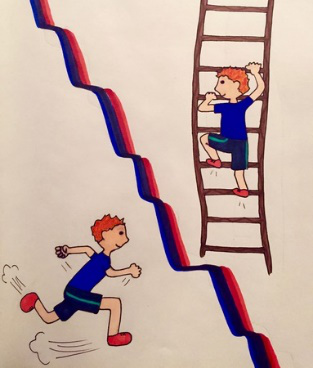
Horizontal or Vertical?
Imagine one person running across a level plane, each step advancing beyond their earlier self, while another climbs a vertical ladder and at every rung counts how many people lie below.
2022.03.08
Audio in Chinese
Related programs

Inequality: Power, Status, and Social Distribution
Why does equality recede the harder we pursue it?
¥98.00
Included with membership

The Social Contract: The Origins and Distribution of Power | Citizenship, Season 2
From human nature to social contract and state formation
¥48.00
Included with membership

Xiang Biao on Society: When Globalization Builds Walls
Where Is Your Life Headed?
¥28.00
Included with membership