



Finding Peace: 40 Introductory Lessons on Buddhism

It is not easy to meet life with an ordinary mind. As society changes rapidly, anxiety and confusion trouble everyone. Busy work and repetitive routines exhaust us, yet we seek a definite self in an uncertain world and extraordinary meaning in ordinary years. Perhaps this is why today’s popular destinations include not only trendy cafés and Disneyland but also temples and lottery shops. As people grow ever more desperate to resolve inner doubts, we might reconsider what our own ordinary mind is and what makes a good season in our own lives.
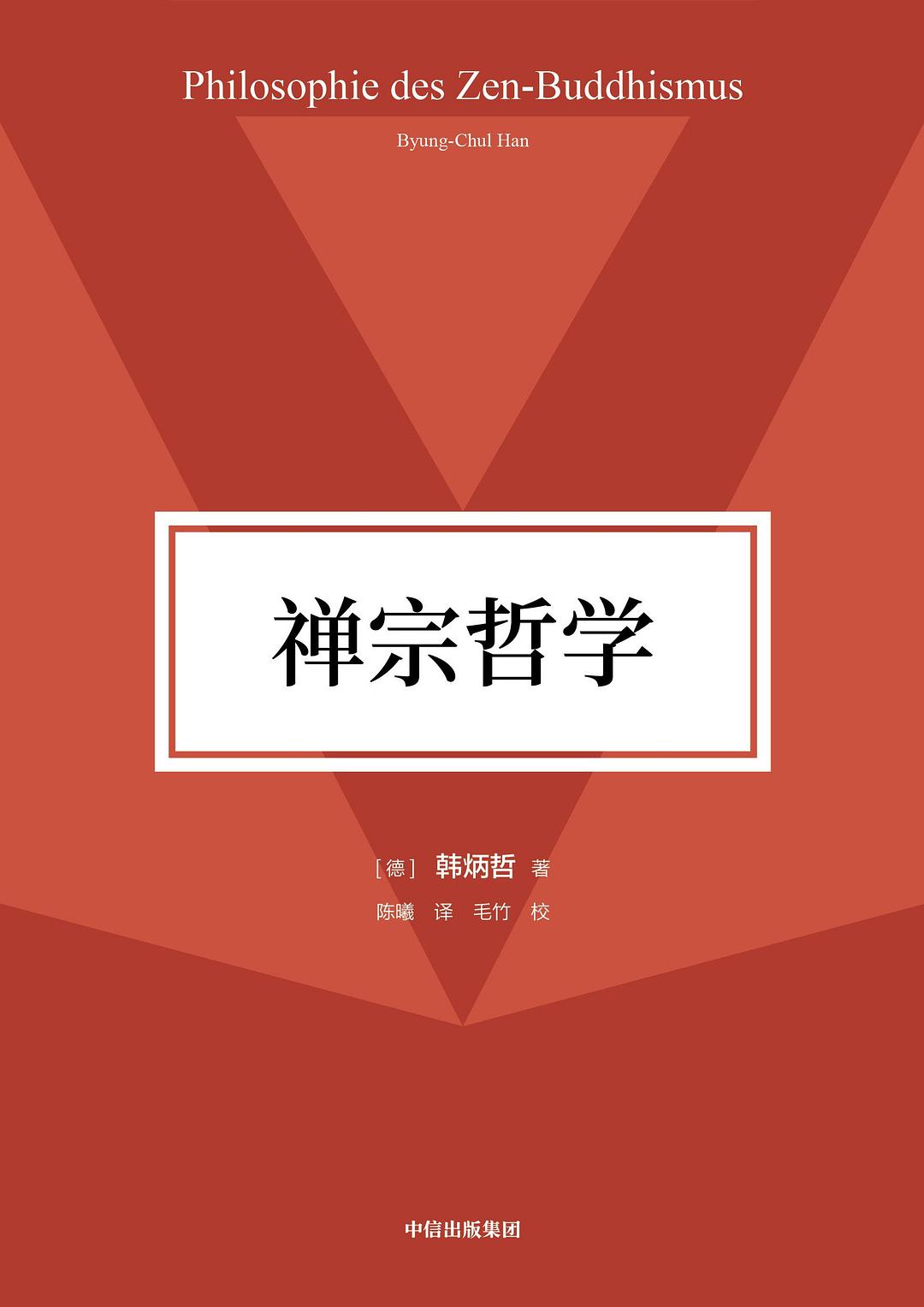
“In spring, flowers; in autumn, the moon. In summer, cool breezes; in winter, snow. When idle concerns do not hang in the mind, every season is a good season in the human world.”The Korean-German philosopher Byung-Chul Han writes in The Philosophy of Zen Buddhism:“What one must do is see the extraordinary antiquity within ordinary repetition. Repetitive time, as time free of trouble, brings the ‘good season.’”What repeats is what matters; only repetition gives us temporality and ritual. But in a world changing from instant to instant, what can be repeated—or called eternal?
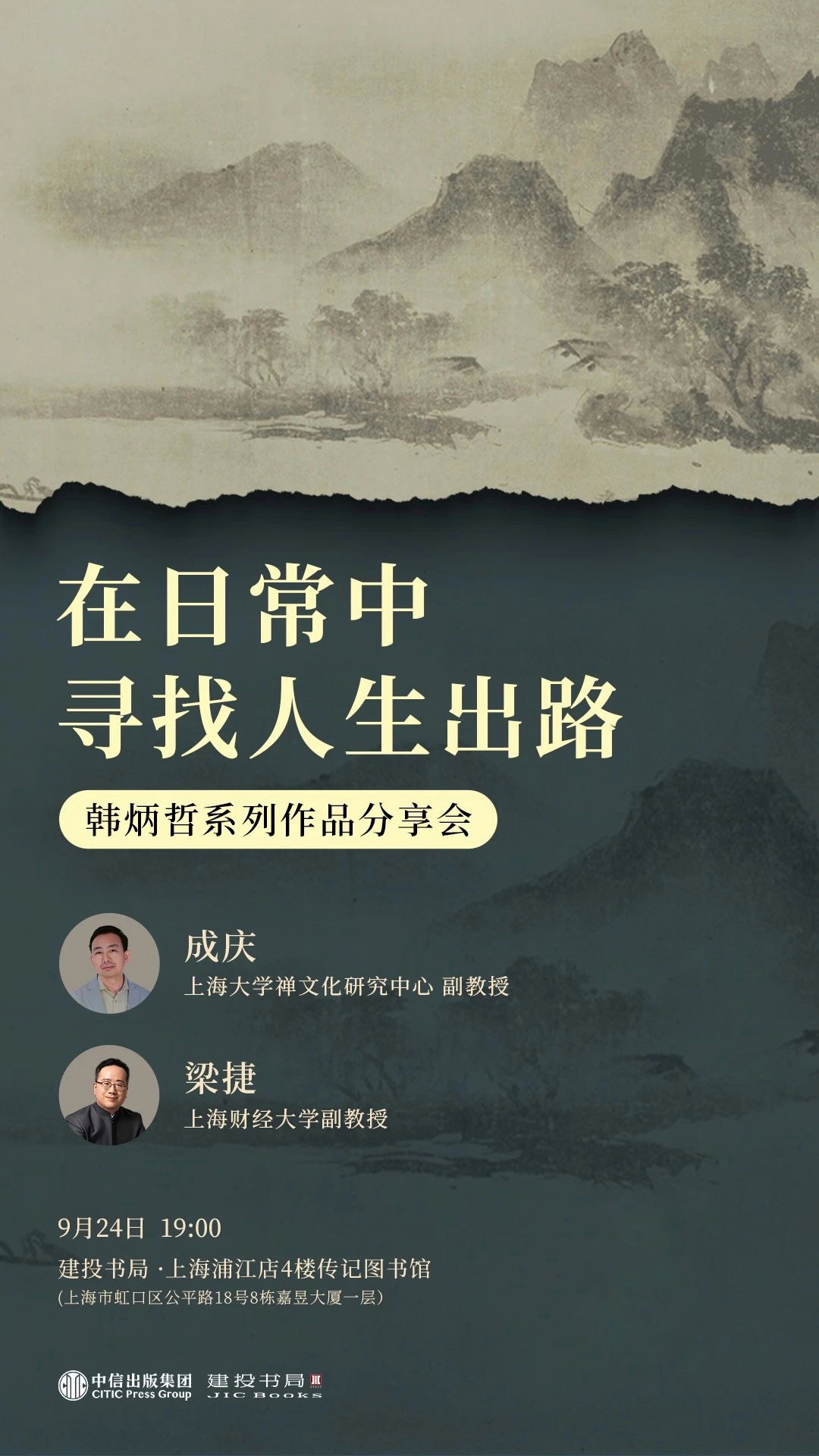
On September 24, Cheng Qing and Liang Jie held a discussion at JIC Books in Shanghai, organized by CITIC Publishing Group. Beginning with Byung-Chul Han’s works, they discussed how we might find a way through day-to-day life in a world full of uncertainty.
Transcript
Cheng Qing:Thank you to the publisher for inviting me. When I was first asked to speak about Byung-Chul Han, I wondered who he was. I had not previously known his work well. After accepting the invitation, I read several of his books. As you know, my professional identity has changed in recent years. I once studied the history of political thought, then turned to Chan and Buddhist history, so I have read relatively few newly published bestsellers like Han’s.
After reading him, however, I felt that for me his work perhaps confirmed that there is nothing new under the sun. Of course, some of his views differ from mine. Today I may speak more about The Philosophy of Zen Buddhism, and ask Professor Liang Jie to discuss the rest.
Professor Liang has been my friend for many years. When we met today, we realized our last public conversation was eight or nine years ago, about a book called Deaths of the Philosophers; I remember discussing some Chan then too. Today we want to use questions raised in Han’s books to ask why he and his work suddenly became so popular.
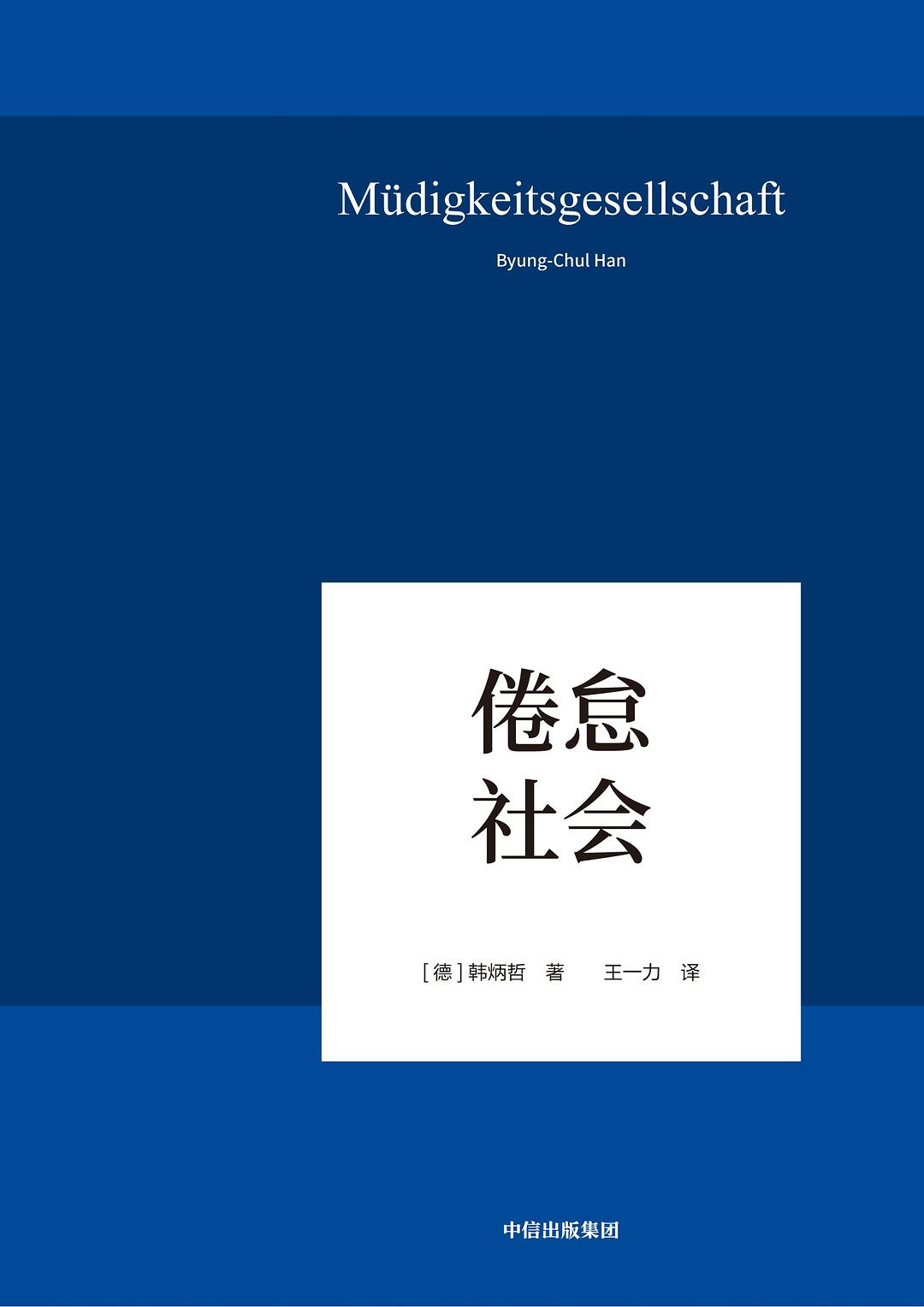
After I began reading Han, I searched his name once, and Xiaohongshu started relentlessly recommending related material. I saw many illuminating comments. But what we really want today is tolook at contemporary society through Byung-Chul Han’s eyes. In earlier years I wrote one essay about being “Buddha-like” and another about involution. Han wrote The Burnout Society, which in our familiar terms could be called the “Lying-Flat Society.” Another of his ideas, the achievement society, resembles an involuted society.
Many of these concepts structurally echo the spirit of contemporary China, although Han’s context differs from ours. I’m curious, Professor Liang: when did you begin paying attention to him?
Liang Jie:Thank you, Professor Cheng, JIC Books, and CITIC Press for letting me discuss a question that actually feels rather distant from me.
I learned Han’s name around 2018 or 2019, not very long ago. Once I knew it, however, he seemed to appear everywhere. Many people around me may never have read Nietzsche or Heidegger, but they have read Han. That is a social phenomenon.
Preparing to discuss The Philosophy of Zen Buddhism, I checked CITIC’s list: it has published eighteen Han titles and apparently plans another dozen or so. He has written over thirty books—simply too many. I have been reading him every day lately and still have not finished. This gives me a strong impression: although Han continually criticizes the achievement society, meritocracy, or what is sometimes called the performance society, he himself is its classic representative. Who writes thirty or forty books in little more than a decade? He writes faster than we can read.
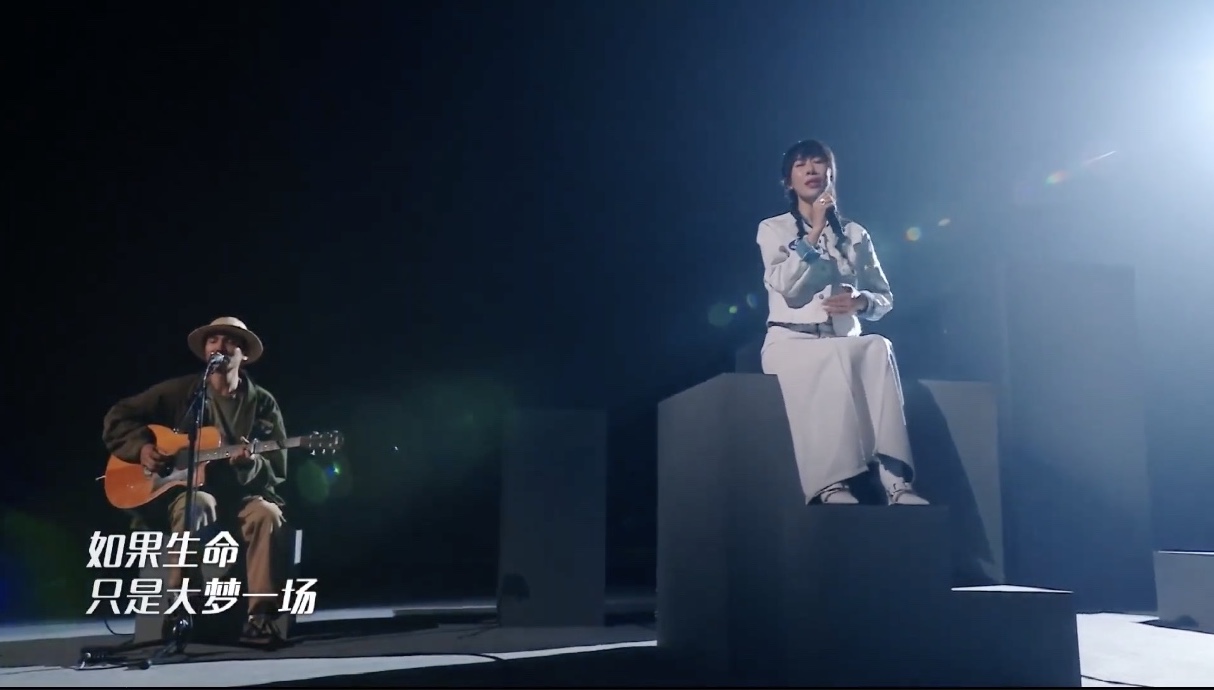
I have also kept asking why he is so popular, why everyone reads and discusses him. Listening to many podcasts while reading his books, I hear his name as frequently as David Graeber, Chizuko Ueno, or Xiang Biao. Young people today, I feel, understand Han quite accurately. Everyone is Han—more Han than Han himself; life is full of him. I need not read him to encounter him: both his books and podcasts make me think of him, and there is no escape. Yesterday someone sent me the song “The Great Dream,” which had flooded social media. My first reaction was: isn’t this also Byung-Chul Han?
That, of course, is an important reason he reaches people so deeply. Yet the phenomenon also contains many problems. Professor Cheng and I hope to share our thoughts about them today.
Cheng Qing:Leaving Han aside for a moment, in recent years being Buddha-like and lying flat became popular among university students, followed by discussion of involution. Chinese society has now reached a bottleneck in economic growth and social development.
I used to warn students that they might live through a major historical era. We imagined only an economic downturn, not a pandemic. During the pandemic, previously hidden psychological symptoms among students were magnified. Depressive symptoms became more common, while their opposite—intensified involution—also grew. In the past two years, civil-service, teaching-qualification, and graduate-school exams have become frenzied pursuits.
When interviewing graduate applicants, even Shanghai University, merely a Project 211 institution, now has an arrogant admissions posture, often considering only graduates of Project 985 and 211 schools. In the past we had to search everywhere for strong students; now graduates of universities such as Zhejiang and Nankai come to us voluntarily. Why?
We can cite many structural social and economic causes, but I think the greatest problem is thatthe view of life Chinese people formed over the past forty years is facing an immense challenge.
I belong to the reform-and-opening generation and grew up during its fastest development. When we graduated, there was no so-called meritocracy. At university we grew freely: whatever subject interested you, you could transfer and study it. I began in electronic engineering but desperately wanted to enter ethnology, somewhat like anthropology. Now I teach Chan history at a university yet have gone years without recruiting a student. History majors prefer mainstream fields such as Tang or Song history and resist religious history, unwilling to be reassigned to Chan history because they assume it has no future. Ten years ago, the atmosphere might have been different; literature, history, and philosophy were popular then.
The modern mentality Han describes as meritocracy has now expressed itself completely in contemporary Chinese society:we involute desperately and seek a supposed standard of happiness that is extraordinarily narrow.
The many voices filling the internet—Xiaohongshu, Douyin, Weibo—are actually homogeneous. The recommendation logic behind big data is frightening. Search one word on Douyin and it continually pushes related content. Compare everyone’s feeds and you can infer each person’s preference; someone who likes pets receives pets without end.
We live in an age of extremely uniform values. In Han’s terms, this relates to the crisis of modern society discussed by Heidegger and Nietzsche. Max Weber, Nietzsche, and others all predicted thatmodernity would bring modern humanity a great cage and constraint:perhapsthe harder we work, the more the system controls us, and the fainter the possibility of a human breakthrough becomes.
At public lectures on Buddhism, I sometimes discuss life’s eight sufferings and possible solutions. Many people reason very simply: life hurts because they have no money, house, or car. Does that not return directly to utilitarian calculation? If I suggest another path—different philosophical or civilizational resources offering other solutions—we still find that everyone begins and reasons along the same single track. This may be our greatest predicament: even when discussing another possible life, our proposed solution returns to the system’s logic.
One major twentieth-century philosophical tradition criticized modernity and modern society. The first Western philosophy I read at university was the Frankfurt School, grounded in cultural criticism—Marcuse’s One-Dimensional Man, for example. It excited me; I wanted to oppose capitalism and cultural hegemony. Yet today our solutions remain structurally identical to modern society’s overarching logic.
At university, we undergo annual KPI assessment. At year’s end, the teaching secretary tells us to log into the system and calculate points: how many undergraduates taught, dissertations supervised, papers published? A CSSCI article is eight points. How many graduate students and student clubs? But after supervising a certain number of graduate students, additional ones no longer count. Students can become surplus, worth no work points, so teachers may calculate that three are enough because more earns nothing.
What does this represent? In Max Weber’s terms, are we not becomingincreasingly bureaucratic, hierarchical, and mechanical? This is the problem in Han’s Burnout Society. Once we call ours a lying-flat or Buddha-like society, those single gestures can hardly confront the system.
When people say, “I’m lying flat,” it often means they strove but could not attain. Buddhism calls this the suffering of not getting what one seeks, one of its eight sufferings: you lie flat because you cannot obtain. But when facing the system’s predicament,we need to see its logic clearly—the logic of Han’s achievement society, which is also Weber’s iron cage of modernity.
I have given many interviews lately because my Buddhism program on Vistopia attracted a fair number of listeners. I wondered: when did Buddhism become fashionable? Audience feedback suggested that amid modern society’s pervasive oppression, people urgently need another intellectual resource. Where to find it is something everyone is trying to explore.
Interviewers keep asking what has gone wrong in modern society. I’d like to hear Professor Liang’s economic perspective. For example, people joke that between going to work and moving upward, they choose to offer incense. Has anyone asked you about this?
Liang Jie:Whenever I answer such questions, people call me patronizing. When asked what to do or how to choose, I truly cannot give young people direction. I can only say that I deeply sympathize with and share their situation. I have no advice and do not want to spill more middle-aged paternalism over everyone. Young people should never listen to advice from people like me.
After studying Han’s books, I think his many works consistently rest on two core assumptions. The first is thatour society is now ruled by neoliberalism, the external environment we must face. Professor Cheng and I both once studied neoliberal theory, yet I still do not understand it fully or know whether neoliberalism truly rules us. Nor do I know Han’s precise definition. Neoliberalism is a basket into which anything can be thrown. Nevertheless, it is an important premise.
The second assumption ismeritocracy or the achievement society. In Han’s view, people once lacked freedom because of external constraints. As Professor Cheng said, when Nietzsche and Heidegger discussed modernity a century ago, they saw human beings trapped in a rational cage. External forces compelled action and genuine freedom was impossible.
With neoliberalism and meritocracy now superimposed, everyone appears to gain freedom. External restraint seems replaced by inner drive. Society tells you that effort will gain admission to a Project 985 or 211 university; more effort will get you into a big technology company; working a 996 schedule will earn eight hundred thousand or a million yuan a year, a home, a car, and a happy family. Society continually urges you upward, and you drive yourself.
Han calls thisthe doping society, forever feeding you stimulants and making you pursue. Young people strive constantly for progress until exhausted. But who actually demanded it? It does not seem to be anyone. Is it really parents or teachers? I teach; how would I dare oppress students and demand advancement? Students themselves ask for exercise books and internships. They involute on their own. Involution means no one else makes you do it; it comes from within.
At a certain point, however, involution has no end and no amount of it secures what you hoped for. The college entrance exam once marked the finish; now graduate exams follow, then civil-service and public-institution exams, endlessly. Liberalism originally promised that effort would change your life. Ultimately, you discover effort is useless because everyone around you works just as hard. Your relative place remains the same and you gain nothing beyond others.
This produces profound weariness and exhaustion. It arises from within because you force yourself to work, drink coffee, and keep a 996 schedule every day. You administer your own stimulants. Han sees this as the root of burnout and calls ours the burnout society.
What should we do in such a complex society? I remain confused and hope Han will tell me, yet his books always leave me dissatisfied. Although numerous, each is thin. What you read sounds good and resonates, but ends before satisfying you. Just as you ask what to do, the book finishes before saying the most important thing. More directly, it prevents us from saying the most important thing.
On my way here, the viral song mentioned earlier looped in my mind: “What should we do?” Yet for me that question has always belonged to the radical left. Lenin wrote a book titled What Is to Be Done?, though young people may not read it now. Earlier, the Russian writer Chernyshevsky wrote a novel of the same name, the first such title I saw. It was regarded as full of revolutionary optimism; Dostoevsky disliked it and wrote Notes from Underground partly to attack Chernyshevsky.
I used to hear “What is to be done?” as an upward, impassioned emotion—blood racing, fists clenched, blood pressure rising. Society is already like this: what shall we do? But in the song, the phrase just continues downward. It does not ask you to answer, only to listen. I asked younger friends because I distrust my taste. They all replied that asking the question is what matters—who asked for an answer? Just listen to “What should we do?”
We were once taught that when a woman tells a man about many problems, he cannot resist offering solutions: do this, do that. Completely wrong. She does not need advice; she needs him to listen to “What should I do?” Listening is enough.
This seems a social trend. People do not expect a clear conclusion. If I want a clear direction, I can list five steps and tell you what to do, but that would be wrong—exactly what Han criticizes and not what people truly want. If Han actually provided conclusions, his books would surely sell less well. What people want is the expression of an emotion, isn’t it?
As I said, young podcasters speak exactly like Han, understanding him far more deeply than I do. To me, they are Han. Some are genuinely outstanding and do excellent work, analyzing society’s pathologies precisely, recording podcasts, and gaining many followers. Every time I think they speak beautifully: they convert deep social understanding into podcasts with which everyone empathizes.
If Han diagnoses the doping society, where constant stimulation produces burnout, I thinkhis books resemble painkillers: how can a society exhausted by so many injections feel a little better?
Han first relieves the pain. But the medicine does not last. When it wears off, you may need another Han book or another podcast. Reading each book really is like taking an excellent painkiller that temporarily adjusts our mood. A song lets us cry and feel slightly better. I strongly dislike those who mock us for taking painkillers or warn us against too many, because their effect is immediate. What else relieves pain so quickly? What comes later is a later concern, not what these books try to solve. Thinking too much about the future would weaken the painkiller, something Han resolutely opposes. I think this is why he fiercely criticizes Foucault.
Those are my basic impressions after reading Han.
Cheng Qing:Thank you, Professor Liang. Perhaps we differ somewhat. I rather like “The Great Dream.” Why? Its final line begins, “If life is one great dream.” That is standard Buddhist language, as in the Diamond Sutra:“All conditioned phenomena are like dreams, illusions, bubbles, and shadows.”。
Many see the song as a realistic description. Why is it so moving? After reviewing their lives within the system, people easily fall into meaninglessness and feel powerless sorrow. At our age, even if life has not battered us severely, we see peers and elders undergo aging, illness, death, family education, and workplace frustration.
I trained in engineering. During our youth, becoming a telecommunications engineer after graduation was an excellent career, yet we have watched even those lives gradually decline. A realistic description today may, as Professor Liang says,merely stir up a wave of emotion, like much art and literature, including Han’s work. ButI see this as an opportunity. It may also become the system reproducing itself: if we merely consume the emotion, it reproduces and fortifies the self—we all suffer, we are pitiable, we are slaves of the system, and nothing can be done.
Professor Liang is more radical than I am, thinking of hard revolution and concentrating on politics and Lenin. Studying Buddhism makes my approach seem softer. Beyond The Philosophy of Zen Buddhism, Han draws on Zhuangzi in Vita Contemplativa. He appears to combine earlier critiques of modernity with Eastern philosophy, using ideas such as non-action and Chan emptiness as resources for criticizing modernity. Heidegger once attempted something similar, though I honestly cannot understand Han’s account of him.
Charitably, I suspect Han tries to use Eastern resources as a reflective perspective on a Western crisis. Whether he understands them correctly is another question. Discussing Daoism, Zhuangzi, or Buddhism easily creates misunderstandings. I am constantly asked whether Buddhist non-attachment means lying flat. Every interview makes me explain it again. Finally, Vistopia produced a provocatively titled interview, “We Went to a Temple to Ask What Letting Go of Attachment Means.” I spent ninety minutes explaining it to two editors.
Han repeatedly discusses the Buddhist concept of emptiness throughthe nonduality of subject and object.He is trying to explain consumerist alienation:when consuming or viewing an object, we ourselves are objectified and alienated by what we view and consume.Once captivated by capital’s logic, you are alienated by capital; while consuming, you are alienated by consumption, eventually becoming a consumer-person or capital-person. Han seems to ask whether another kind of philosophical thought can resolve this. He discusses looking at art and society, calling it contemplation, and wants to keep us from being alienated amid the dazzling modern consumer world. The simplest example is livestreaming on Douyin.
From my perspective,modern short videos continually manufacture bubble-like dream worlds and draw you inside.Once you enter the dream, everything is easy for them; their fear is that you will not enter, right?Many purveyors of speech and ideas seek a magical effect. They use various means, all ultimately making you believe them.Many Douyin videos say, in effect, “Believe me,” repeatedly confirming that you must believe.
Han, I feel, seeks to resolve an epistemological predicament at its root. We all talk about burnout and involution, but he asks how goals such as admission to a Project 985 or 211 university became life’s highest value.
This is why I often encourage Jingdezhen drifters—young people who go there to make ceramics. Many struggle. A documentary showed impoverished young potters using communal kilns at staggered hours because private kilns are expensive. With such limited resources, becoming wealthy is extremely difficult.
Yet more young people keep arriving. Perhaps an atmosphere has formed in which a younger generation discovers a possible break from conventional life.
Returning to Han, without reflecting on how our values are shaped, the problem may have no answer. We will speak forever of burnout and involution. I tell students not to care whether they pass the graduate exam because society outside is vast; their eyes reply, “Who believes you?” So we ordinarily encourage them to work hard and enter Tsinghua or Peking University.
Many have never questioned whether they might skip this path, forgo graduate school, start working, or accept arduous work with relatively low returns. Most minds resist the moment we say it. During our youth, life unfolded step by step. Today the internet instantly shows every possible life: wealthy, poor, and afflicted. Because of big data, many choose never to see lives of suffering.
What world do you see? An information cocoon: the happy lives you see define what yours should be. But that is impossible.
The internet shows us lives unimaginable in the past while simultaneously telling us we can never live them. This causes profound spiritual frustration. We no longer strive gradually, reach a stage, recognize our limit, and accept fate. Now we reject fate from the start; even kindergarten children do. A mother told me her child asked after school why a classmate’s mother drove that car while their family drove this one. Involution is not merely workplace pressure or manipulation. Our values have adopted one logic, placing us all on the same track.
A fortune-teller once told me my wealth palace was empty. Suddenly I felt at ease. I had dreamed of becoming rich, but this reminder seemed to help me accept myself and know what I could and should do. Accepting fate opened a new door: I could do what I wanted. When told today that we cannot become rich or succeed on the mainstream track, most of us despair. That is a cognitive problem.
The Buddha-like and lying-flat questions in Han’s Burnout Society show that social thought has reached a major turning point, but what follows is troublesome.If we repeat “burnout society” like Xianglin’s Wife endlessly recounting her misery, we may produce what Professor Liang described: perpetual questions with no account of change. Change does not mean a specific instruction about what to do, but seeing where the logic and problem lie.
Han seems to repeat Heidegger’s approach while using other resources, including Chan philosophy and Japanese Zen scholarship. But I think he only offers an epistemological reminder. Readers may not need his diagnosis repeated; Xiaohongshu has already diagnosed us quite well.
I often treat platforms such as Xiaohongshu and Douyin as important sources. Whenever I lack material for social diagnosis, I find it there. When I lose touch with life’s suffering, I watch Douyin. After one video of a cancer patient, the platform recommends more, each more tragic than the last. We decide what to view. I tease my students: stop watching cats all day. Watch long enough and you nearly become one; your consciousness contains nothing but cats, doesn’t it?
My preliminary conclusion is that Professor Liang tends to want Han to offer a plan. I think Han may be more cunning: he has one, but presents it in a difficult form.
Perhaps Han realizes that a concrete plan is no longer possible in modern society because information varies so greatly. Paradoxically, the logic behind diverse individual cases is so rigid that none escapes it. Young people have thought clearly: if marriage traps me in pregnancy and childbearing, I will not have children. I surveyed university students about marriage, and nearly all said they did not want it.
Marriage concerns an important modern problem Han often discusses: humanloneliness. He calls itthe disappearance of the Other; Xiang Biao speaks ofthe disappearance of the nearby。
. Discussing human relations, Han calls today’s achievement society affirmative because it affirms the self. Each person’s self becomes powerful, producing thought that begins and centers on me. What then is the relation between another and me? In Chan terms, it becomes a hard, solid me confronting a hard, solid other. ButChan teaches that people mutually enable and fulfill one another.The technical term is dependent origination: causes, conditions, and circumstances.
Here too, Han seems to seek a looser structure between self and other.Nietzsche said marriage is a long conversation, emphasizing interaction. Habermas discusses intersubjectivity. Han diagnoses modern society as emphasizing individuality and subjectivity, thereby producing cruelty toward others.
Consider how we view the workers encountered every day. In elevators, I often press the button for delivery riders and chat with them, because many have grown accustomed to being ignored, excluded, and isolated in residential communities. We behave as though a person were merely an object serving us. Yet everyone wants to break interpersonal isolation, and many fear contact with others or feel socially anxious. We overlook what we fail to do in daily life: we continually reinforce relations based purely on service and commercial exchange.
So, Professor Liang, how do you view human relationships?
Liang Jie:Professor Cheng raised many excellent points that need sorting out. In the state Han calls the burnout society, it is difficult for people today both to do something and to do nothing. We are caught in that contradiction.
We often complain that students no longer answer questions, however much we encourage them. At the start of each term I say: there are too many of you for me to remember; anyone seeking a high grade should answer often, so I remember you and give a better participation score. They would rather forgo the points than answer.
Cheng Qing:Then no one needs to make an impression.
Liang Jie:Society now seems universally socially anxious. On meeting, people first ask whether you are an introvert or extrovert in MBTI terms, then determine how to communicate. Interpersonal communication has become difficult, and student-teacher exchange nearly impossible. My generation may have lacked sufficient politeness toward teachers: we simply asked questions without psychological burden. Today students carry a heavy burden and dare not speak. Posting a question on Xiaohongshu feels natural; asking a person feels unnatural. Encouraging questions asks them to act against nature and meets resistance. Doing things is hard, but not doing them is hard too. Suggest fewer practice problems and certificates, more exhibitions and lectures, or a gap year, and students will curse you—not in person, but online—for asking them to act unnaturally.
Han wrote The Burnout Society, not The Lying-Flat Society, which is interesting. I have pondered “lying flat” for years and asked many people, yet still do not fully understand it. Many say it is extremely hard and almost no one truly does it. People complain and proclaim it, but do not actually lie flat. Professor Cheng mentioned young people from various majors going to Jingdezhen to make ceramics. Such people are probably becoming fewer, not more. A finance, computer-science, or law graduate who goes to make pottery seems to waste prior study and lose prospects; professionally, that is lying flat.
Yet such a person must radically pursue an entirely different life, on a trajectory unlike every university classmate’s. To me, that is lying flat in a sense, but few can choose it. Everyone complains about fierce competition in graduate and civil-service exams. Every track people care about is crowded. The Jingdezhen track is less competitive: you make yours and I make mine; your bowls do not stop mine. Still, we cannot tell students to skip exams and go to Jingdezhen. They would hear it as “Why don’t the hungry eat meat?”
Truly lying flat is very hard. I once met the contemporary Japanese artist Hajime Matsumoto. His idea convinced me he is a real artist: he will never work, but will survive happily and wonderfully. This is not living off parents; no one supports him, and he neither steals nor robs. He survives without a job—perhaps caring for Professor Cheng’s cat in exchange for several meals—and still organizes many art activities.
Someone who can live an entire life without parental support, savings, or employment is a remarkable artist. That radical artistic attitude is true lying flat.
Lying flat is radical. Recent reports describe how young people resist. Some stay up gaming until two or three in the morning purely so they can sleep in class. Ask why they work so hard at gaming instead of sleeping earlier, and they reply: if I sleep early, how can I fall asleep in class tomorrow?
Only such a radical method permits lying flat. We talk about it constantly, yet lying flat and involution are similar. A cliché says the upward and downward roads are the same road. To lie flat truly, abandon competition: do not take graduate or civil-service exams and stop doing exactly what everyone else does.
Every visible track is competitive and grows narrower; the competition is endless. First enter a Project 985 or 211 school, then choose finance. One wrong step ruins every later step. At our finance-and-economics university, students specialize in competing ferociously. Yet the best investment banks recruit very few people.
I learned this as a student. At a major investment bank’s recruitment session, a hall of hundreds was full. After an enthusiastic presentation, the speaker urged everyone to apply and retain hope: the previous year they had hired one person in Shanghai. That chilled me completely, and I never attended another. Yet people still compete this way along a single track. Han recognized the prevailing state: too exhausted to compete, too restless to lie flat.
Few will completely stop pursuing graduate school or civil service, disregard social insurance and retirement, and let everything go. My friends and I seemed genuinely unconcerned with insurance or retirement when young. I may have reached today by lying flat. Only recently have I tried to understand what social insurance means; in youth, we scarcely considered it.
Cheng Qing:We checked the deductions only when our pay seemed too low.
Liang Jie:We did not know the future would become this. Young people now face immense pressure, which I fully understand. Their turn toward being Buddha-like, lying flat, or listening to Professor Cheng’s program is understandable. Yet my crude impression of Buddhism differs from many listeners’: Buddhism is radical, especially Chan, an extraordinarily radical religious or philosophical school.
Chan often teaches through blows and shouts. These are not merely figurative. Reading about them produces no reaction because we have not experienced them. In a monastery, a wooden stick truly strikes you.
Professor Cheng leads enthusiasts in Chan retreats. Try sitting full lotus. I cannot manage it; my legs soon hurt. If you fall asleep while sitting, the teacher’s stick may descend.
Chan is radical and has a strict standard: awakened or not. The sole criterion is whether your teacher judges that you have passed, not how hard you worked. This utterly opposes meritocracy. Effort does not guarantee awakening. Meritocracy assumes effort raises a foreign-language score from forty to sixty, then eighty. In Chan, effort alone is useless: either one hundred or zero. I worry about people frustrated and unable to lie flat who now pursue Buddhism. Are you prepared to abandon worldly pursuits? Do you think Chan will make you calmer while continuing to compete? Read seriously and you will find Buddhism harder, not easier, than secular life. Genuine practice will frighten you.
People must seriously consider which road to choose. You must take a step and choose from the heart, but that may be extraordinarily difficult. Most are accustomed to drifting with the current and echoing others. They fear even the road less traveled, much less one never traveled. People say economic decline and the spirit of the age make individual effort meaningless, so one must follow the times.
But to excel differently, you must do something different. Everyone reads Han; few dare become him. A Korean trained in metallurgy and engineering, he abandoned a lucrative field, traveled all the way to Germany, and studied Heidegger. What does Heidegger have to do with life, and how does reading him feed you? Many have asked. Han avoids this crucial question. After years of study, he found work in Germany and did make a living through philosophy and Heidegger. Ordinary people should ask whether they want to become Han or merely take his painkillers. The former may require abandoning finance or computing to study an obscure but beloved subject in Germany or France that offers no civil-service path. Would you? That is a major choice.
Would that choice be lying flat? Professionally, you differ from peers. Perhaps finance feels impossibly competitive and morally empty, so you abandon it entirely and take Han’s arduous road. What did he pay to achieve and write what he did? Reading his books and feeling his sympathy is one thing; walking his road is another. Everyone should consider the difference.
Cheng Qing:We sometimes think another person’s way of life can be copied, but it cannot. Professor Liang is right that Chan is radical because it changes our most fundamental cognition and epistemology.
Buddhism and Chan teach that cognitive alienation arises from dualistic thought. As just discussed, what you view shapes who you become; that is dualism.
What epistemology does Buddhism or Chan ultimately seek? Tosee clearly the illusory nature of every fixed self-understanding that might shape you.Chan and Buddhism do not tell you to lie down or suppress desire. They ask you to seedesire’s illusory nature.Everyone experiences consumerism, but different people consume with different cognition and attitudes.
I live near Zhongshan Park and am a homebody, sometimes not going downstairs for a month until my family drags me to eat at Raffles City. Entering can feel frightening. The social environment seems alien: others see a shrine to consumerism, while I feel discomfort. This opposition is not ideal; Chan says carrying water and chopping wood are the Way, so practice should be at home in every setting. Why the feeling? It is cognitive. After a month reading sutras at home, a suddenly dazzling fantasy realm naturally feels unreal.
Daily information continually shapes the cognition that only this is good. Escaping it, from Chan philosophy’s perspective, requires a veryradical cognitive transformation.Professor Liang is partly right that the harder one practices Chan, the more one fails. Greater effort can mean greater attachment: the apparently good goal you pursue turns into its opposite.
Yet deciding not to practice or act is no solution either. Neither doing nor not doing works—so what does? This is where Chan cases arise.
The cases are fascinating. Professor Liang has read the Five Lamps United at the Source and surely knows many. External conditions influence us; trying hard to overcome them pushes us into their mirrored opposite. What then? Buddhism says do not attach or adhere. In real life, enter Raffles City and shop if you like; if you cannot afford something, walk past without dwelling on it.
Usually, unable to afford it, we resolve to work hard and buy it someday—meritocracy. If you see the price, exclaim that it is expensive, and cheerfully walk on, that is non-attachment.
Reading Han in the reality of contemporary Chinese life, I thinkunless we complete a major readjustment of cognition or underlying logic, we may read Han forever and gain intermittent comfort without ever changing how we know.
At universities today, everyone discusses publishing, finding a good job, and becoming a professor quickly. Without a cognitive challenge, East China Normal, Fudan, and especially Shanghai University all feel the same.
After studying Buddhism and Chan philosophy, I discovered that one need not involute. You may apply for projects without caring about the result. When my college recently said my proposal had not passed screening, I replied, “Wonderful.”
I have never felt that I was lying flat. I am simplyfinding my own rhythm of life.。The larger rhythm of society is standardized, but each person needs to find their own.
Professor Liang diverted my topic before we discussed human relationships: colleagues, family, marriage, partners, and society. I have thought about this for years—today’s problem ofloneliness.
I recently read A Biography of Loneliness, which says loneliness is a modern phenomenon. People in the past could be alone but were less often lonely because they were internally connected to cosmos, society, family, and country. Chinese frontier poetry, for example, often makes poets seem alone but not lonely, because they remain connected to a larger spiritual and social order. Modern people feel lonely and closed off because they have lost connection with others.
Economic and social structures, including family relations, have reached a stage requiring renewed examination. Each person must consider their relation to others. Han offers no sociological solution. During Shanghai’s pandemic restrictions last year, every residential compound formed an owners’ chat group. I thought community public space might finally reorganize itself because everyone enthusiastically helped and ordered groceries together. Once restrictions ended, the groups spent all day arguing about inadequate property management and unfinished tasks.
What logic lies behind this? Why is sustained mutual aid so hard? There must be a cognitive problem beneath it.Each of us works to build a good life for ourselves but seldom considers helping others live happily. Extending kindness to others is uneconomical under modern efficiency-first logic.
That is why I press elevator buttons for neighbors and delivery workers and chat with them. From an individual level, I want actively to improve human interaction. At least an exhausted courier or taxi driver may feel a stranger’s concern and have a slightly better day. This is something each of us can do. Professor Liang, back to you.
Liang Jie:I must answer the question of human relationships seriously.
People today are indeed distant and lonely. Yet every relationship—colleagues, teacher and student, intimate partners, parent and child, spouses, strangers, friends, classmates—contains danger. Two people may instantly connect and speak wonderfully, then discover different views of an idol and fall out. Human relations therefore feel subtle and dangerous.
A mainstream way of exploring relationships today is to consult a guide. University students prepare excellent guides to choosing instructors. If Professor Cheng and another teacher both offer Chinese history, and the other gives high grades while Cheng gives low ones, students already know. The guide certainly says never choose Cheng. Like a game walkthrough, it warns you away from the hard road and toward the easier one.
I once accepted guides for courses and exams. Now they cover everything: joining clubs, eating with classmates, attracting a girlfriend, and cultivating a professor. Sometimes a student asks me a question after class and we chat happily. If I suggest lunch to continue, the student becomes nervous. They have not read a guide to eating with a teacher.
This summer a student sent me a polished PDF of nearly one hundred pages explaining how to spend four years at our university: academic track, internships, graduate school—every route detailed across eighty or ninety pages. I admired shortcuts I had never known. A week later, another student asked whether I knew its author. Curious, I said no. It was written by a high-school senior about to enroll, before spending a single day here. I envied that preparation and wished I too could see a guide, though perhaps it is too late.
People read guides to avoid injury, wasted effort, and frustration. Choose Professor Cheng without checking, and life may be ruined. One slightly lower grade affects the GPA, scholarship, graduate recommendation, future million-yuan salary, ability to buy a Shanghai apartment, and therefore marriage. One wrong step ruins everything.
People fear mistakes and unforeseen consequences of contact. If a teacher likes me less after lunch, will it affect my GPA and future? A guide may say that instead of cultivating teachers, cultivate senior students: teachers may be wrong, but seniors are surely right.
Relationships really are subtle and different. I study intellectual history and often read great people’s lives, but cannot treat them as actionable guides. Actionable guides all seem to lead to mediocre lives that do not appeal to me. As an outsider studying some Chan, my experience differs from many people’s.
Chan cases have no standard answer; everyone’s answer differs. A teacher asks a student a question and approves the response. The student writes down the answer and lends it to a classmate. Asked the same question, the classmate repeats it exactly, and the teacher strikes them. Why can the same question have different answers? Why is Chan not an exam? Why are you right while I am wrong, and why is copying the answer still wrong? It is unscientific—and it is Chan. Chan reflects traditional human relationships, including teacher and student.
We once spoke of teaching according to the student. Teacher-student relations are subtle and tense; one teacher must respond differently to different students. The same person is different with different friends. There is no uniform standard. I speak one way to Professor Cheng and another way to someone else. Human relations are plural, complex, and bound to present circumstances; no standard template applies. A life lived by guide is not a life.
Han’s theory should move us similarly. Listening to excellent young podcasters eloquently repeat him in nearly identical terms, I wonder: in a world so large and a China so populous, how can four medicines—Han, Graeber, Ueno, and Xiang Biao—be enough? Do we need painkillers or a doctor? Han is Korean, went to Germany in the 1990s to study Heidegger, and wrote about problems that were largely American, perhaps German-American. He did not face China’s present 996 culture. Our situation is unrelated to his. His writing grew from a Korean and East Asian person’s particular experience in Germany.
Yet today we say Han speaks perfectly for us and voices universal truth. From the Chan he admires, consider this: Han may be right, but when you repeat him, the same words may no longer be so right.
I keep thinking about this. Whenever everyone finds no problem with concepts such as meritocracy or neoliberalism and thinks they adequately describe society, I begin to doubt them.
Harvard philosopher Michael Sandel’s The Tyranny of Merit discussed meritocracy in America. Han describes it as a Korean in Germany. When we say it perfectly describes our meritocracy too, I wonder whether Chinese society truly runs entirely on merit.
I do not fully understand civil-service exams. Are public jobs really awarded entirely by test score? Does the strongest answerer or a Tsinghua or Peking graduate certainly pass? Reality seems more complex. What is tested and what counts as merit differ by city and region. We advance through primary school, middle school, and the college entrance exam, but the merit tested there differs from what employers, civil-service selection, workplace competition, and each role’s KPIs reward. Every concept needs discussion. When finance, feminist, civil-service, marriage, and overseas-student podcasts all sell me Han, either someone has misread him or Han himself is wrong.
Reading Han feels comfortable, immediately easing pain and making us cry. That is fine in the moment. Afterward, however, we must think further. We cannot merely read or repeat his words and routines; we must ask what our own understanding is. Changing the world is exhausting, difficult, and different in every society. Han turns us from society toward the self, asking us to inspect inner pain as self-driven. That seems easier but actually makes everything harder. Han is both the best masseur and the greatest anesthetist.
Cheng Qing:I agree with one of Han’s ideas:when describing a social phenomenon, we should not repeat ourselves.In The Philosophy of Zen Buddhism, he quotes Wumen Huikai from the Gateless Gate:“In spring, flowers; in autumn, the moon. In summer, cool breezes; in winter, snow. When idle concerns do not hang in the mind, every season is a good season.”Yasunari Kawabata also cited this in his Nobel lecture. To many, Chan has always seemed mysterious yet deeply desirable.
Returned to real life, however, it becomes simple. Chan master Dazhu Huihai said that the awakened person merely eats well and sleeps well, without countless calculations and thoughts. We scroll Douyin while trying to sleep and curse the boss’s manipulation while eating. “When idle concerns do not hang in the mind” does not ask us to give up or lie flat. We may establish a real-life goal without letting it bind us.
Traditional society offered many goals, but conditions limited each person’s possibilities. Traveling in Japan, you find artisan families making one thing—pottery or handmade glasses—for seventy, eighty, or a hundred years. Sociological and economic explanations are easy: Japan’s social strata are stable and offer few upward channels.
Chinese people cherish exams because they have long seen them as an important route for changing class destiny. But suppose most people cannot reach society’s top and even crossing classes grows more difficult.
I once visited Hōzō-in, a famous sutra-printing workshop beside Manpuku-ji in Kyoto. An elderly retired craftsman, often interviewed by NHK, had spent his life in a tiny room printing scriptures among woodblocks and palm brushes.
He spoke with great enthusiasm, pulled me around the workshop, and pointed out blocks from the Kan’ei era and other periods. Why do people today, with better material conditions, so rarely show such happiness?
People who spend a lifetime doing one thing seem to have greaterinner autonomy.I have therefore set myself one lifelong task without changing subjects. Hearing that someone became rich or bought a large house, I feel envy for a moment and let it end,because I know what I can do and truly love.
Modern society promises that all of us can do anything—nothing is impossible. In fact, everyone encounters a ceiling from birth. We may overestimate our lives and suppose every possibility is ours. I realized early that we should look downward more often: perhaps we are ordinary people. I am happier as an ordinary teacher and can do that one thing well.
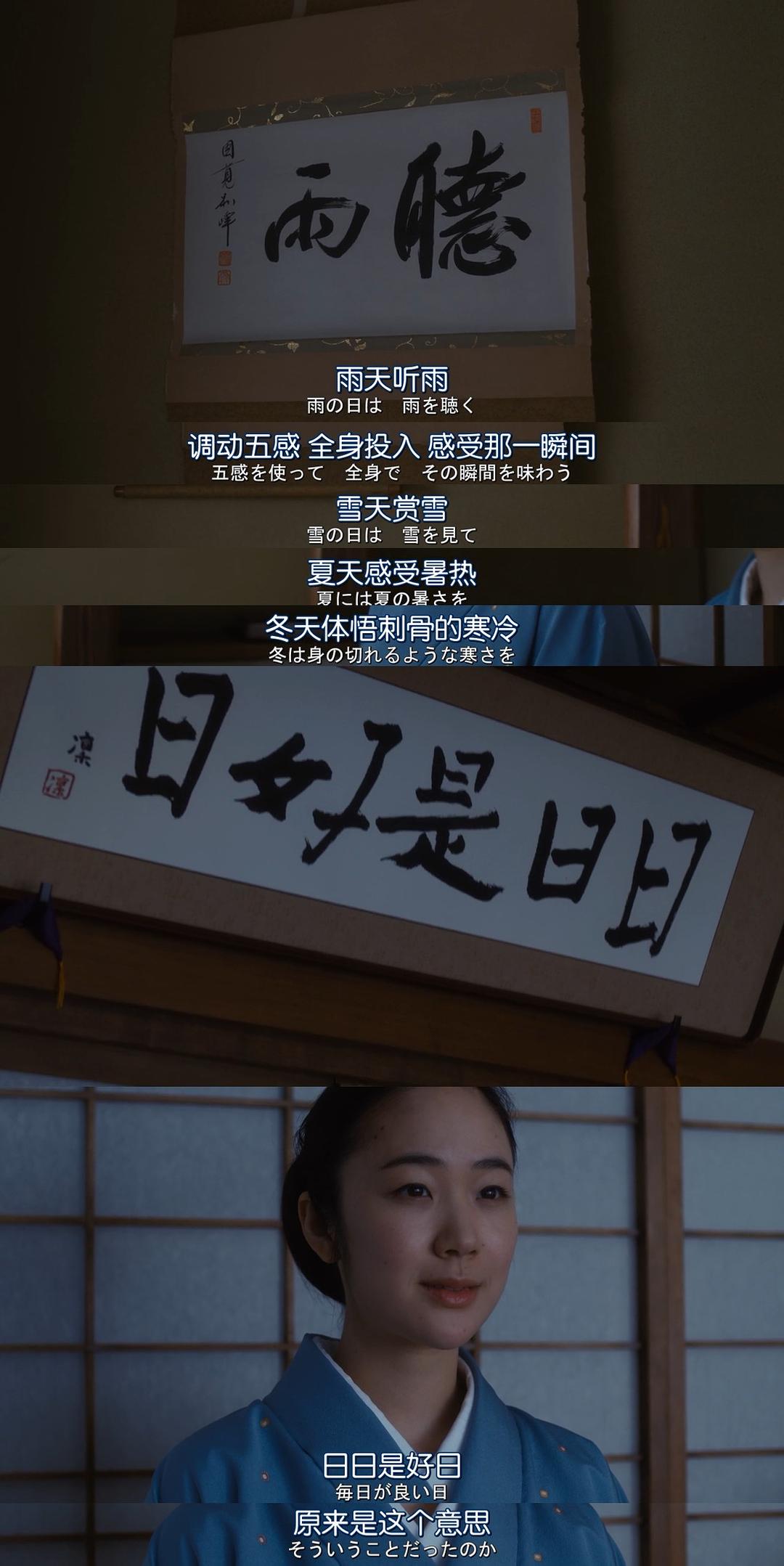
The tea ceremony has a famous saying: “Every day is a good day.” Why? Becauseevery encounter in life—meeting another person, meeting tea, meeting everything that happens each day, including wind and rain—is each person’s unique experience. Yet modern people always live somewhere else.Rain feels annoying; wind feels cold.
The Japanese film Every Day a Good Day, starring Haru Kuroki, contains this line:“Engage all five senses and give your whole body to that instant. On rainy days, hear the rain; on snowy days, watch the snow; feel summer’s heat and winter’s piercing cold. So this is what ‘every day is a good day’ means.”Most people find such happiness difficult to experience.
The Gateless Gate says, “When idle concerns do not hang in the mind.” Han asks us to understand the ordinary mind. I do not know his exact meaning, but Chan has an important saying: “The ordinary mind is the Way.” What is that mind?Everything in life is beautiful in itself, depending on whether you meet it with an equal gaze. Yet modern people always live in others’ expectations, worlds, and dreams, and therefore cannot live a genuinely self-sufficient life.
Consider the viral song “The Great Dream”:if we remain in endless narration of suffering caused by reality, we never reach genuine happiness. We speak of reality in order to find our own road. Instead, at different times, people are moved and their sadness is stirred, but the wound forever heals and is torn open again.Why? Perhaps because we have not seen the extremely rigid cognitive pattern hidden within modern minds.
From my perspective, I am curious why Han wrote an entire book on Zen philosophy. I think he glimpsed thatcertain Eastern ideas may offer modern society useful points of reference.This partly explains why people today have renewed interest in Buddhism, Daoism, and other traditional Eastern thought.
2023.11.08
Audio in Chinese
Related programs
Ten Philosophers' Proposals for Living
Philosophies of life from Socrates to Sartre
¥198.00
Included with membership
A Journey of Wonder: A Concise History of Western Philosophy
One hundred philosophical adventures with Zhou Lian
¥198.00
Included with membership

Ambiguity: A Philosophical Guide to the Japanese Imagination
Beyond The Chrysanthemum and the Sword: understanding Japan through philosophy
¥28.00
Included with membership