



How China Confronted Change: The Qing Dynasty

Hello, I am Yang Zhao.
The Secret of Ming Longevity: A Bureaucracy Intensely Loyal to the Emperor
We continue our history from the Ming to the Qing, beginning with several necessary shifts in historical perspective.
Earlier accounts of the Ming–Qing transition gave the “Southern Ming” a special status. They portrayed those who defended the surviving Ming regimes—from Shi Kefa to Koxinga—as tragic heroes, emphasizing their loyalty to the emperor and willingness to die for dynastic legitimacy.
But instead of treating the Southern Ming in isolation, consider a continuous history of relations between literati and imperial power from the Zhengde, Jiajing, and Wanli reigns onward. Compare Ming loyalty with loyalism in the Song and with the political beliefs inherited through the Confucian classics these scholars read. From this broader historical viewpoint, we have to adjust both narrative and judgment.
In the relationship between scholars and the emperor, the Ming took a wrong turn from Zhu Yuanzhang's founding of the dynasty. Departing from the basic pattern of earlier Chinese history, emperor and scholar-official no longer cooperated in governing. The emperor stood high above, exercising direct command, while officials below obeyed and carried out orders.
After the Zhengde and Jiajing reigns, the Ming clearly lost effective imperial leadership and effective court government. Operations of power around the throne became highly dysfunctional because emperors were incompetent and inactive. One indulged excessively in pleasure; another went on strike out of spite; another acted willfully and massacred ministers. Why did the Ming survive so long under these conditions?
Because it possessed a bureaucracy able to operate automatically while suppressing itself—never protesting and never challenging imperial authority. When the emperor at the center became incapacitated, the system continued to run. It offered admonitions through established channels but could not shake or alter the style of imperial rule, much less threaten or compel the throne to adjust.
Seen this way, Ming history acquires a very different meaning. We encounter a peculiar scholar-official system: a thoroughly indoctrinated value system that placed loyalty to the ruler above every other principle.
Measured by imperial loyalty, late-Ming and Southern-Ming scholar-officials were extraordinary, willing to make immense sacrifices for emperor and dynasty. Measured by an intellectual's knowledge and thought, or by recognition of and commitment to principle and reason, however, they failed. They could offer no principle to check imperial power and therefore preserve no independent consciousness of value.
Was “Restoring the Ming” Really Worth Celebrating?
Against this intellectual environment of profound assimilation, we can better appreciate Wang Yangming and the importance of the school he founded. The Wang Yangming school preserved, with difficulty, the true seed of learning: to think while reading, to question and seek answers through study, rather than blindly accepting established explanations and answers.
Looked at another way, had more scholars read and thought in this manner—had the Wang school extended its influence beyond one branch of Neo-Confucianism accepted by a minority—the Ming's absolute imperial power could not have survived as it did.
Transmitted to Japan, the Wang Yangming school became a value consensus among the samurai during the Edo period and then a philosophical foundation of bushido. It later supplied a principal social force driving Japan from the overthrow of the shogunate to the Meiji Restoration. This gives us a glimpse of the philosophy's potential for action.
After the Ming fell, many scholars remained loyal to the ruling Zhu family, and people from different classes joined movements to restore the dynasty. Was this genuinely worthy of affirmation? Why did earlier narratives automatically celebrate it? Simply because the Ming was a Han regime and the Qing a Manchu one: from an ethnic standpoint, surrender to outsiders was unacceptable.
But is that reasoning truly sound?
Jin Yong's first martial-arts novel was The Book and the Sword. Its central premise is that the Qianlong Emperor was not Manchu but Han. His Han brother Chen Jialuo and the Red Flower Society therefore try to reverse his allegiance, transforming him from a Tartar emperor into a Han emperor and realizing the dream of overthrowing the Qing and restoring the Ming.
Only a little over a decade later, when Jin Yong wrote his final martial-arts novel, The Deer and the Cauldron, he abandoned that ethnic position. The Han Heaven and Earth Society is consumed by internal conflict, while a Manchu emperor consolidates rule through the people-centered promise to “never increase taxes.” How can a dynasty founded by Han Chinese necessarily be better than one founded by Manchus?
Jin Yong also wrote Sword Stained with Royal Blood, set amid the upheaval at the end of the Ming. It had to confront the facts that the roaming rebels were also Han and that Li Zicheng's regime was appallingly brutal. The novel explains the rebels' failure through Li's corruption after entering Beijing, but Jin himself was clearly not convinced. Beginning with the death of Yuan Chonghuan, he had to portray the Chongzhen Emperor, including the emperor's frenzy in hacking at his daughter before taking his own life. Jin could not help wavering from his original racialist position.
The historical fact is that the Ming regime had not established enough abstract, noble values to deserve scholar-official loyalty. What, then, did they serve? They served the court and the ruler. Even after nearly a century without a decent ruler, and with rulers accomplishing scarcely anything worthwhile, scholar-officials remained loyal.
To preserve their own positions within the regime, they naturally joined with palace eunuchs and kept the state bureaucracy functioning. On one side, factions fought and undermined one another over affairs of the imperial household. On the other, scholar-officials jointly tended the peasantry and tax base so the state could continue to exist.
Under these conditions, was continued loyalty to this dynasty and regime really so reasonable?
Ready Wealth—or a Ruined Land?
Earlier history placed excessive emphasis on this part of the story, a choice driven by hostility toward the Manchus. We need not follow that principle today. Different principles, angles, and perspectives reveal different sides of history.
Western sinologists, unburdened by ethnic conflict between Han and Manchu, saw a different history. Before Mark C. Elliott provoked controversy over the “New Qing History,” their work on the Ming and Qing broadly followed two clear lines:
First, the Ming was generally seen as a period of vigorous popular life, with cities and commerce reaching astonishing heights. The court, by contrast, was no longer the country's true center because it could not lead society. Indeed, the “advance of the people” occurred precisely through the “retreat of officials.” The most significant changes erupted where the court could not reach.
Second, descriptions of Manchu Qing rule should begin with the actual political and social conditions the Manchus faced when they entered China proper. They did not enter an enticing China, an easy prize ready for enjoyment. There was no stock of wealth they could simply seize by force. This was a China ravaged by roaming rebels, an agricultural land in ruins, and a governmental apparatus not merely disabled briefly but disintegrating after prolonged decay.
The historian Frederic Wakeman, Jr., therefore titled his focused history of the early Qing The Great Enterprise.
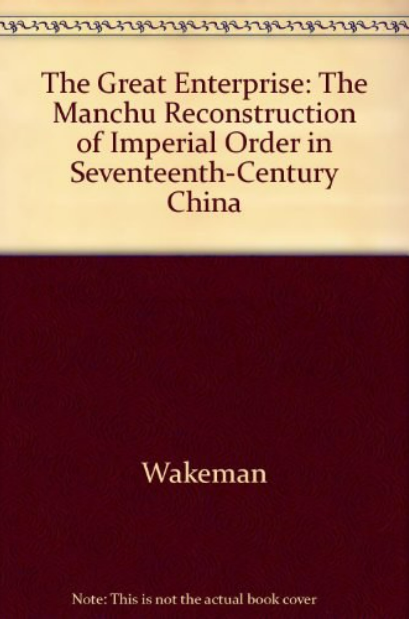
Cover of Frederic Wakeman, Jr., The Great Enterprise, University of California Press, 1986
To remain inside the passes, the Qing had to commit themselves to a tremendous problem: restoring China's political and social order and rebuilding effective government under conditions of ruin. From a broad viewpoint, this is an achievement that Han-centered history and the revolutionary cry to “expel the Tartars” absolutely refused to see or acknowledge. At the level of detail, Wakeman reminds us that this was an enterprise far beyond ordinary imagining.
The Manchus certainly had ambitions, but they could never have expected to enter China in this way and rule the whole country so quickly. The realm suddenly fell upon them before they were prepared.
The pivotal year was 1644, when two great events coincided. Li Zicheng's rebel forces entered Beijing and the Chongzhen Emperor hanged himself. Meanwhile, the Manchu leader Hong Taiji had died the previous year; his ninth son Fulin, only six, succeeded him, and the following year became the first year of Shunzhi. On the nineteenth day of the third lunar month in Chongzhen's seventeenth year, the reign ended and the Ming lost its capital. The Ming upheaval struck the Qing just as it had lost its own leader.
In that year, many historical forces truly converged to produce an epochal transformation.
Thank you for listening. Until next time.
2025.07.17
Audio in Chinese
Related programs

Kodansha History of China, Season 9: The Ming and Qing Eras
Sea and empire
¥48.00
Included with membership

Ten Talks on the Meiji Restoration
Japan's Rise, Told for Chinese Listeners
¥28.00
Included with membership
Modern China’s Childhood: 33 Lectures on Late-Qing Institutions
How did an ancient celestial empire become a modern state?
¥128.00
Included with membership