



In the summer of 1939, floods struck Tianjin and our whole family sought refuge in Shanghai. The British concession stood on higher ground, so relatives from other districts came to shelter in our home. Before long our area flooded as well, and the lane became a lake. Fortunately, several steps led up to our front door and the water did not enter. My youngest sister was still an infant and had just recovered from a serious illness.
Father decided to send us to Shanghai. He could not leave his work at a bank in the French concession, which had not flooded. One morning he hired a small boat. Mother took the three of us sisters, together with our nanny and her daughter, out through the lane to Tanggu, where we boarded a steamship for Shanghai.
It was my first voyage on a large ship. In calm weather, the limitless water truly resembled green satin, tugged and shaken from both sides to raise layer after layer of waves. Our Chinese reader included Ba Jin's essay on watching the sunrise, so I deliberately went on deck early and found the sight indescribably beautiful. Mother had to care for my two younger sisters. Neither she nor I was seasick, but the nanny was dreadfully ill, so Mother had to care for her as well. No one had time to watch me, and I happily ran about freely looking at the scenery.
In Shanghai, as usual, we stayed with my maternal uncle. After summer vacation, I joined my cousins in the first year of upper primary—fifth grade—at Weifeng Primary School. It was a private school whose principal and most teachers had attended the McTyeire School for Girls. The principal had studied in the United States and was a lifelong unmarried professional woman devoted to education. It was a typical “lane school,” housed in an unremarkable building and not especially famous, but its teachers were quite good.
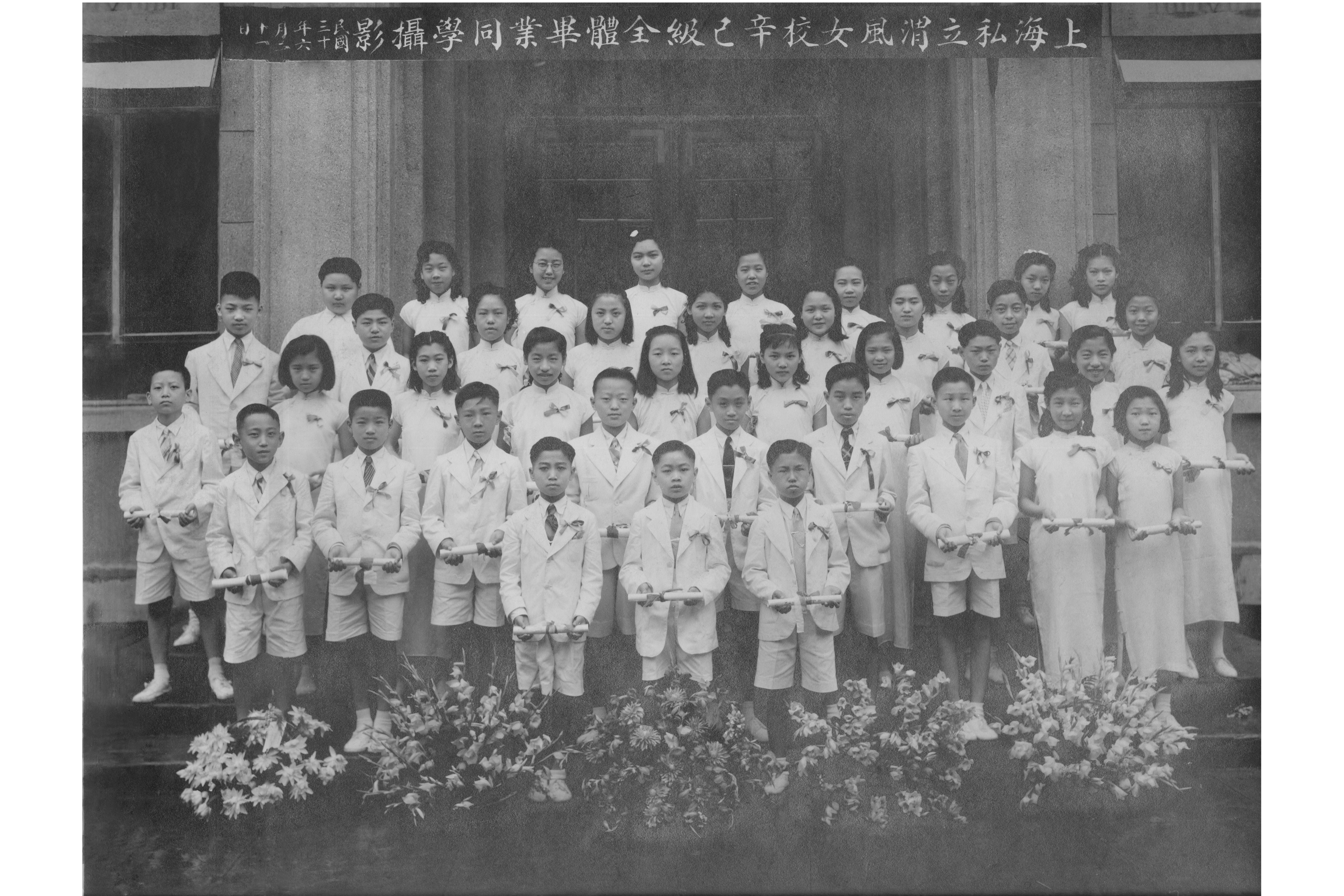
Weifeng Primary School graduation photograph
The author is at far right in the second row
Shanghai primary schools began teaching English in third grade, while my Tianjin school did not begin until junior middle school. Weifeng initially refused me because my English was inadequate.
Because all my cousins attended and my other subjects were strong, people pleaded on my behalf. The principal made an exception and admitted me provisionally. I had to catch up in English on my own and pass the year-end examination to become a regular pupil; otherwise I would leave or repeat a year.
I had never feared study and was confident. I did not hire a tutor; fortunately, older cousins could help. I crammed for a year with the school's textbooks and not only passed the final examination but earned excellent marks. I entered sixth grade smoothly and remained a “good student.”
My classmates spoke Shanghainese, while at home I spoke the Huzhou dialect and was often teased. Before long, I learned fluent Shanghainese too. Besides “Chinese literature,” the curriculum included “National Language”—Mandarin taught with phonetic symbols. The teacher's pronunciation was standard, perhaps because she came from the north. Naturally, this was my strongest subject.
Soon the Tianjin flood receded and the whole family returned. To avoid interrupting my studies, I remained alone in Shanghai to finish upper primary.
By coincidence, the school also valued classical Chinese. In final examinations, the principal personally interviewed pupils in both Chinese and English. She came to the classroom, selected students at random, and assigned a memorized text to recite. For English, we read a passage aloud and explained it in Chinese. I remember that my final English oral used the story of the tortoise and the hare. I passed every time and made a good impression on the principal.
Only the final Chinese interview before sixth-grade graduation went badly. I drew Han Yu's passage beginning, “Only after a Bo Le exists are there horses able to run a thousand li.” After several lines, I stuck. I repeated myself but could remember no more. The principal broke precedent and prompted me with a line, yet my mind remained blank. I wished the earth would swallow me. The incident left a deep impression; I still cannot recite the whole essay today.
At term's end, the school held its customary parents' gathering, where pupils performed. The graduating class was central. There were two English plays. One told of Washington and the cherry tree, a story from our English textbook: young Washington chops down his father's beloved tree. His furious father threatens severe punishment, but little George bravely admits what he has done, and his father rewards his honesty with forgiveness. Two boys in our class performed it.
The other was a very simplified one-act Sleeping Beauty with many roles. An older and taller pupil played the lead; I was the goddess of wisdom, one of seven fairies, and had one line. I also appeared between scenes with two classmates, wearing tall clown hats and reciting an English tongue twister in front of the curtain. These few minutes of performance thrilled me. I did everything possible to persuade my aunt to attend. She came and afterward said she had never imagined Zhongyun possessed such talent. I was happy for days.
After the twenty-first century began, a Weifeng classmate suddenly contacted me—the boy who had played young George Washington. We were all very old. At his initiative, several classmates still reachable in Beijing gathered at the home of Zhou Ganzhi, who hosted us. Zhou later studied architecture at Tsinghua and joined the underground Communist Party, eventually serving as vice minister of construction. He was retired when we met and has since passed away.
Freed from Mother's supervision in Shanghai, I followed my interests still more freely and browsed voraciously outside class. One wall of my uncle's home was covered by a cupboard crammed with unsorted old and new books. During those two years I devoured a great many: Dream of the Red Chamber, Ba Jin's Family, Spring, and Autumn, martial-arts and supernatural tales, translations, and much else. I burrowed in completely at will, often emerging covered in dust, with no supervision or guidance. Whenever I found something interesting or formed an idea, I discussed and exchanged books with cousins near my age. It was delightful.
I began encountering New Literature. Magazines such as Short Story Monthly and Van Jan passed from my cousins' hands to mine. The “big books” I read included Ba Jin's Family, Spring, Autumn, and other works such as Autumn in Spring and Cold Nights. I also began Dream of the Red Chamber then, understanding it only vaguely. I gradually grasped it after rereading it several times as an adult.
Ba Jin's works influenced me profoundly and awakened me against feudal values. In my own compositions, I would “force sorrow into new verse” and write sentimentally—surely laughable now. Meanwhile, my mathematics declined and I became narrowly literary.
Unlike Yaohua School, Weifeng allowed classroom compositions to be written with a fountain pen rather than requiring a brush. Without supervision, I stopped practicing calligraphy properly. My brush writing never recovered. Back at home, Mother concentrated on repairing my mathematics and did not force me to practice. When I later met Chen Lemin, whose calligraphy was excellent, I gave up still more completely. For an intellectual of my generation, being unable to produce presentable brush calligraphy is a major regret.
My uncle's home was a lively extended household. He had six children, four daughters and two sons, in addition to relatives staying for long or short periods. At New Year or a major birthday, all our Shanghai relatives came—my eldest aunt also had six children, four sons and two daughters. People ran upstairs and down until the house resembled a theater. In daily details, their life differed slightly from ours.
My uncle's family was more traditional; ours was somewhat more “Western,” perhaps because Father had studied in the United States. My uncle's extended household had ancestral tablets in the main room and rites for ancestors at New Year. Our nuclear family was simpler and dispensed with those formalities. My girl cousins mostly wore qipao as children, while we usually wore skirts. We sisters learned piano; our cousins did not, but often watched Peking opera and all could sing it.
Under their influence, I became interested in Peking opera. Radio stations broadcast request programs after school. One of my great pleasures was listening with the opera handbook Xikao and learning word by word, sometimes with a girl cousin two years older. I learned enough passages to assemble performances. We could perform “Sitting in the Palace” from Silang Visits His Mother and “Wujiapo” from The Red-Maned Steed in full. A boy cousin my age sang the older male role; my girl cousin and I alternated female roles. Our repertoire also included film songs, especially Lang Yuxiu's “Song of Family Happiness” and “Falling Flowers Adrift,” as well as songs from the then-popular collection The World's 101 Best Songs.
When I was ten, my cousins and I mounted a real program. Every winter, Shanghai organized disaster relief through radio and newspapers, mobilizing families to donate money and goods. We used this as an occasion for a “charity performance.” With adult support, we invited every aunt and distant relative in Shanghai and sold tickets at whatever price each guest wished to pay. One cousin kept the accounts. Everyone was enthusiastic and ingenious, searching adults' trunks for antique clothes, altering garments, and making sets.
Several cousins were versatile. My cousin Tong Benyi was only eight but seemed able to do anything and imitate everything. He appeared in several numbers and was everyone's darling. He even copied theater vendors, hanging a tray from his neck, filling it with sunflower seeds and peanuts, and moving through the audience to sell them. People found him charming and bought a little, adding to the donations. He later fulfilled that talent as an outstanding arts worker and served as stage manager for the large-scale 1964 song-and-dance epic The East Is Red.
Our program included song, dance, and Peking opera. We originally planned my cousin Tong Xiaoli's “Sitting in the Palace” from Silang Visits His Mother as the penultimate act, with my performance of Wang Baochuan in “Wujiapo” from The Red-Maned Steed as the finale. Tong Benliang played the older male role in both. The arias in “Wujiapo” are beautifully designed, and I had especially loved the erliu passage beginning “Pointing toward Western Liang, she curses aloud……,” which I had practiced repeatedly with the radio.
During rehearsal, however, Tong Xiaoli and I began discussing the story and found it increasingly troubling. Xue Pinggui secretly marries Princess Daizhan while Wang Baochuan waits for him in a cold cave. He then deceives Wang, saying her husband sold her, and plans to kill her and return to the princess if she submits. What right did he have? It was terribly unfair. Could Xue be called a good man? We grew indignant, and with my cousin's support I refused to perform it. This was my first “anti-feudal” action.
From then on, my commitment to equality between women and men remained exceptionally strong. The New Literature I read in Shanghai, especially Ba Jin, probably exerted a considerable influence without my realizing it. Children had organized the program themselves. Older children presided but did not “lead,” so if I refused, that was that. I no longer remember what replaced the piece.
To this day, I consider the complete Peking opera The Red-Maned Steed artistically refined, especially in its arias, but ideologically rotten. The problem is not merely gender equality, for which one cannot judge a story of that era too harshly. More seriously, it promotes currying favor with wealth and power. Even by traditional ethics, riches and rank overwhelm filial duty, fraternal respect, loyalty, and trust. In the final “Grand Enthronement,” the alternating and combined singing of Wang Baochuan and Princess Daizhan is nauseating.
When I later met Chen Lemin, who knew Peking opera better than I, we discovered that our views of the work coincided exactly. I never imagined then that modern television dramas and other programs today would still promote these corrupt values, intensified through combination with materialism.
At my uncle's I always felt as if I were at home. My aunt managed the household loosely and seemed rarely to inquire into her husband's work or her children's studies. Compared with Mother, she participated less in my uncle's circle of friends and seldom accompanied him to social engagements; her contacts remained among relatives. Yet every child achieved excellent marks and behaved well. Perhaps this was an advantage of having many children. By high school, the eldest daughter already held great authority and her younger siblings obeyed her. In any case, with such a large, noisy household, children running everywhere and floorboards thudding all day, no one could have managed every detail.
Looking back, my aunt's task was not easy. My uncle strictly observed duties to family, accepting every request from relatives. She was broad-minded and never appeared impatient. Though she seemed not to manage closely, she handled heavy responsibilities lightly, keeping order amid chaos and arranging everything properly. I never saw the quarrels common in traditional extended families. I also noticed that the couple stayed up late. When the house finally quieted, they often shared a drink and played several games of chess. My aunt said this was the only time that belonged to her, showing that she too had little choice about all the “liveliness.”
*Drifting Through a Changing World: Zi Zhongyun's Memoir at Ninety was published by Oxford University Press in 2019. The electronic edition is available exclusively from the Zi Zhongyun Digital Library on Vistopia.
Editor: Jiarong
Preview ended. Subscribe to read the full article.