



I will begin with the first issue: the security system. Broadly speaking, the mechanism was established between the Tehran and Yalta conferences. The later San Francisco Conference and other meetings followed principles already agreed. The system was essentially in place by Yalta in February 1945.
The Soviet “Island Mentality” and Postwar Security Strategy
I want to address several questions, beginning with Soviet security strategy. What exactly was it? We must first understand the “island mentality” formed over many years. After the October Revolution succeeded in 1917, the Soviet state entered civil war while capitalist countries refused to recognize it. Recognition came later; the Soviet Union joined and then left the League of Nations.
In short, the Soviet Union remained surrounded by capitalist states and felt profoundly insecure through the eve of World War II. Under these conditions it formed a simple security strategy: “territorial expansion, exchanging space for time.” The basic approach was to enlarge national territory as far as possible, directly control or occupy strategic locations, and then create a ring of “buffer zones” around the state.
By the mid-1930s, the Soviet Union had formed this strategy and specified its goals. First, it sought to control Baltic access to the sea and its northernmost connections with Europe. It believed that a secure zone required occupying the three Baltic states. Second, it wanted to control Finland, close to the port of Leningrad. Third came Poland, historically an invasion route into Russia—the “Polish corridor.”
These goals were realized through the secret Soviet–German protocol. The Soviet Union had considered collective security in negotiations with the West, but Britain and France would not accept its territorial demands. Hitler did. In August 1939, the Soviet Union and Germany signed the secret agreement. Hitler accepted Soviet occupation of the three Baltic states and promised not to interfere with an attack on Finland. A glance at the map shows that Finland's geography left no other country able to intervene if Germany stood aside.
Third, Germany and the Soviet Union agreed to divide Poland, attacking from west and east respectively. Soviet territory could thereby expand outward on a massive scale.
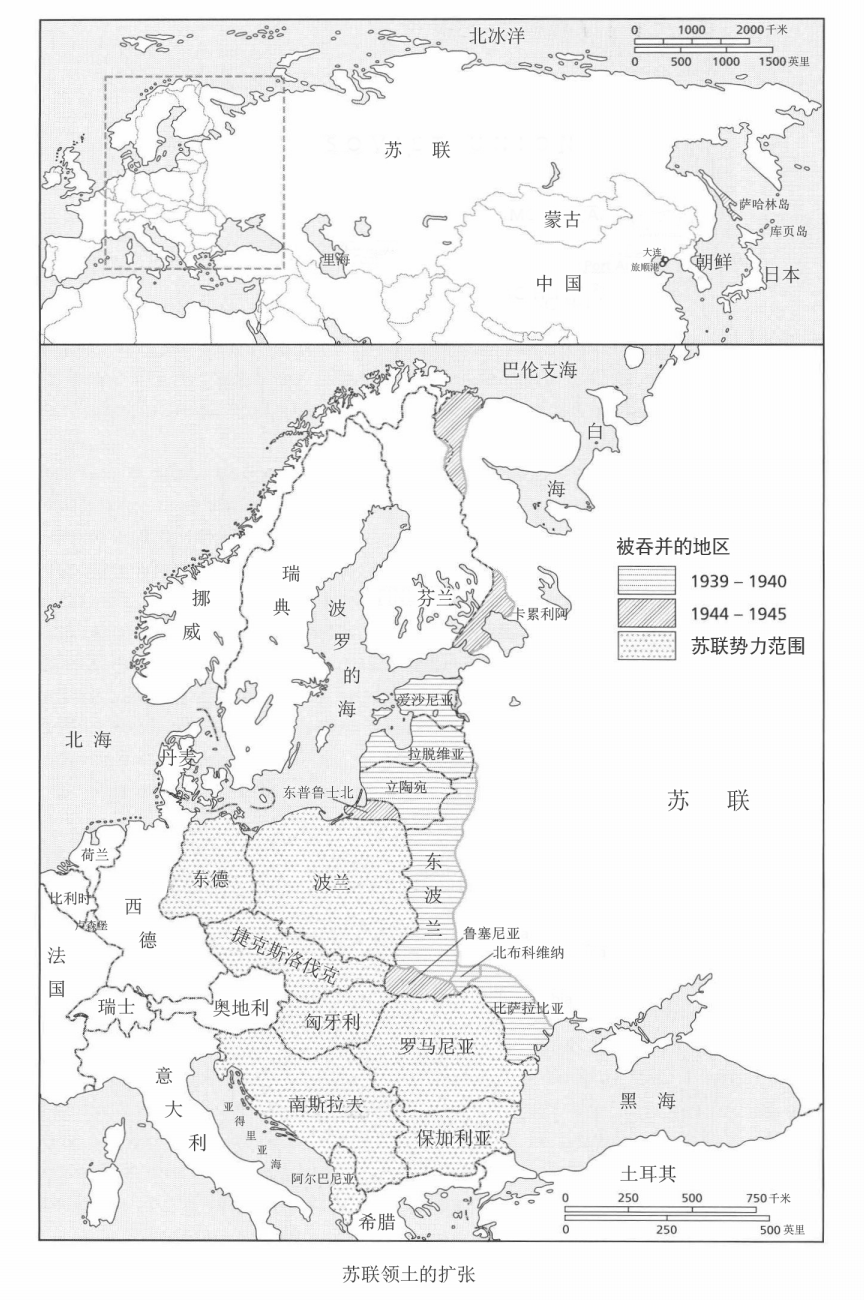
Geographical reference for Soviet territorial expansion
Why, then, did the German–Soviet war begin? The Soviet security strategy included one more area on its southern flank: the Balkans. The Balkans became a central issue intensifying conflict between Germany and the Soviet Union. The Soviets wanted the region; Hitler refused because he intended it for Italy. He told the Soviet Union to expand east toward Afghanistan, India, and then Japan. Stalin, however, believed that the Balkans and the Black Sea coast posed the greatest threat to Soviet security and had to be controlled.
Stalin believed that controlling the Balkans would give him control of the Black Sea coast, followed by the Turkish Straits, turning the entire route to the Mediterranean into a Soviet security guarantee.
Because the two sides could not agree, Hitler attacked the Soviet Union before defeating Britain. Yet the Soviet security strategy was realized during World War II through Anglo-American guarantees for postwar Soviet security. Put simply, Britain and the United States ultimately accepted the conditions Hitler had rejected.
The Postwar Global Order of Joint U.S.–Soviet Management
Structurally and institutionally, Franklin Roosevelt designed the United Nations as a platform consistent with his principle of great-power unanimity: the United States would oversee North America, the Soviet Union Eastern Europe, Britain Western Europe, and China Asia. Each of the “Four Policemen” would handle and take responsibility for affairs within its security zone, while the great powers held vetoes. So long as they did not conflict, the world would remain peaceful.
In substance, however, the principal powers were the United States and Soviet Union. Britain had already declined and China, though counted as a great power, remained weak. This was the later idea of a G-2: “joint U.S.–Soviet management.” It was Roosevelt's basic conception of global security governance, and Stalin strongly agreed.
The United States had originally opposed dividing the world into spheres of influence. When the Atlantic Charter was announced in August 1941, it specifically stated that it did not include postwar territorial questions. Washington later discovered that excluding territory made the Soviet problem impossible to resolve.
By the Tehran Conference at the end of 1943, the principles of postwar political cooperation were basically established through the Four Policemen, each responsible for an area. This differed from colonial spheres of influence: the areas were primarily zones of responsibility, one managed by this power and another by that one.
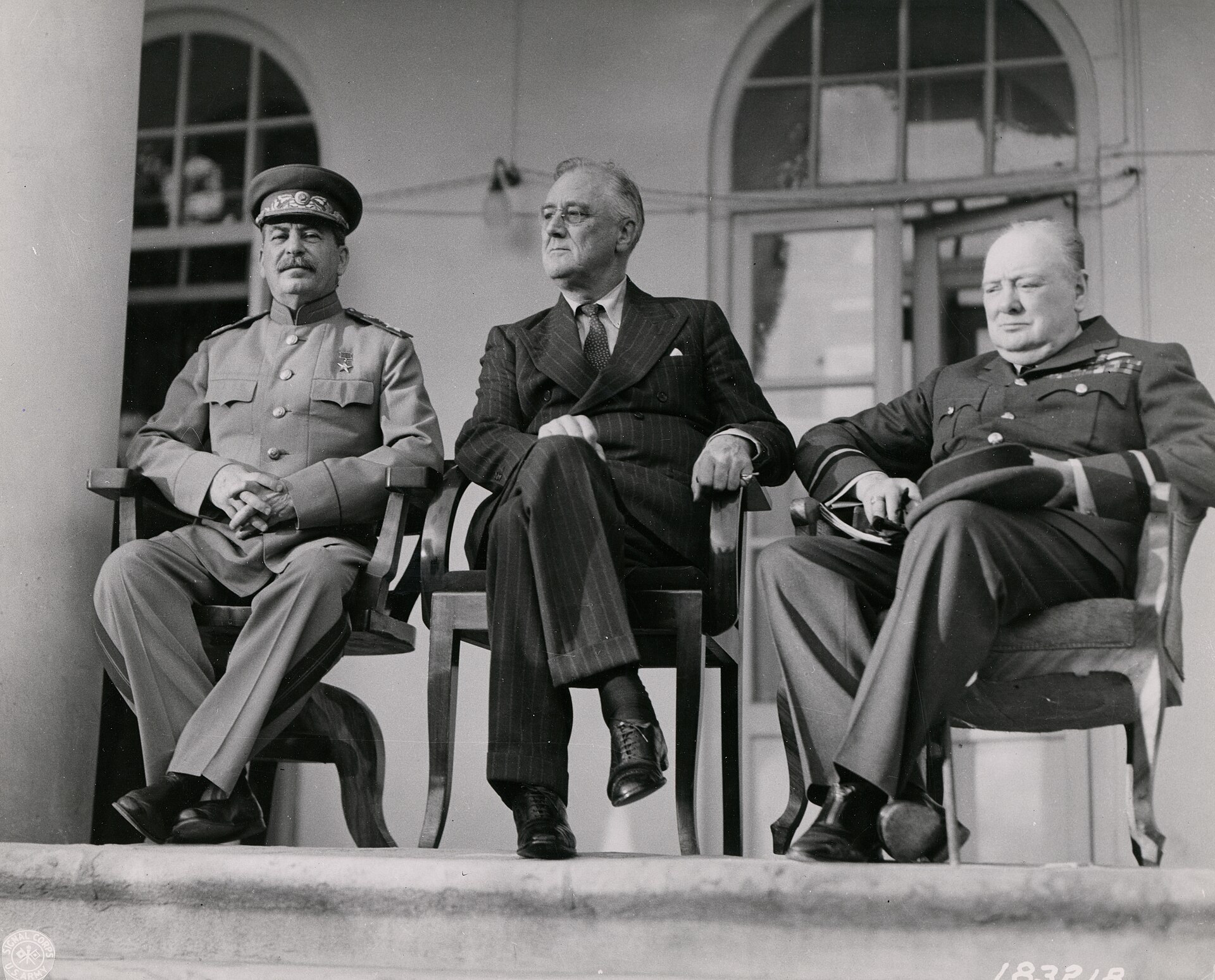
The Tehran Conference, November 1943. From left: Stalin, Roosevelt, and Churchill. Roosevelt explicitly proposed the postwar Four Policemen strategy during the conference.
The other powers ultimately accepted earlier Soviet demands. First came the Baltic issue, then Finland, where the United States and Soviet Union agreed to handle matters according to the prewar situation. Before resolving Poland, the Soviet Union settled the Balkans through the famous Percentages Agreement.
In October 1944, Churchill met Stalin in Moscow and marked percentages on a piece of paper: the Soviet Union would hold ninety percent influence in Romania and seventy-five percent in Bulgaria; Britain would hold ninety percent in Greece and the Soviet Union ten; Yugoslavia would be divided equally. The United States initially objected but later acquiesced, clarifying the Balkan spheres.
At Yalta, the prewar situation was recognized and, most importantly, the Polish and Far Eastern questions were resolved. In Poland, a large area was shifted westward to the Soviet Union. To compensate Poland, parts of Germany were transferred to it. Soviet territory therefore expanded west. The Curzon Line and Polish question were settled.
After the conference, East Germany, Poland, Hungary, Romania, Bulgaria, Yugoslavia, the Balkans, and Albania all entered the Soviet sphere. The result gave Soviet security not only a geopolitical guarantee but an institutional one through the United Nations.
Geopolitical Divisions of Postwar U.S. and Soviet Responsibility
The Soviet Union also settled its Far Eastern concerns at Yalta, chiefly by controlling the Sea of Japan. It recovered southern Sakhalin and acquired the Kuril Islands. Together with the division at the thirty-eighth parallel, this placed the Sea of Japan's surrounding control zones in Soviet hands. The one unresolved location was the Tsushima Strait, which became relevant to the Korean War and later events. If war had resolved the Korean Peninsula in the Soviet Union's favor, the entire region would have entered its sphere.
From the Aleutians to the Kurils and China, the Soviet Far East gained security. Another crucial question was China. The Soviet Union sought control of Outer Mongolia, which required Mongolian independence, and of northeastern China through the Chinese Eastern Railway and Port Arthur. This was why the United States and Soviet Union jointly pressured Chiang Kai-shek to sign the Sino-Soviet Treaty of Friendship and Alliance in August 1945.
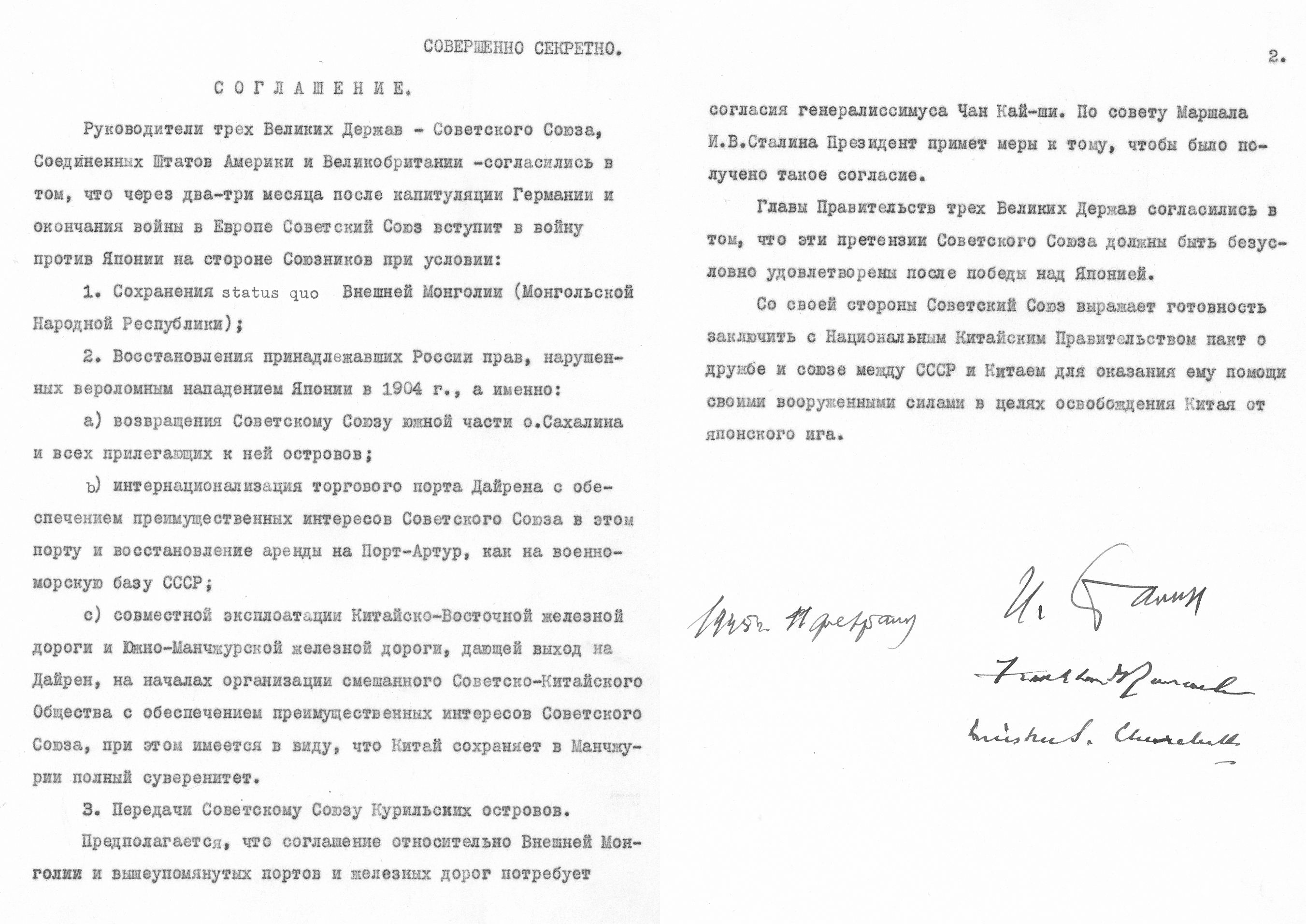
Russian original of the Yalta Agreement. Its first provision states: “The status quo in Outer Mongolia—the Mongolian People's Republic—shall be preserved.”
Stalin was therefore highly satisfied on security. But American concessions had conditions. In exchange for so many benefits, the Soviet Union had to promise not to impose authoritarian one-party systems throughout these regions. It could control countries within its zone of responsibility but could not turn them all into replicas of the Soviet Union.
Stalin agreed. Even before the issue was formally discussed, he understood that the United States would raise it. In May 1943, before the Tehran Conference, he proactively dissolved the Communist International. The Battle of Stalingrad had just ended early that year and the European war was turning when Stalin abolished the Comintern.
The immediate goal was to encourage Britain and the United States to open a second front; the long-term goal was to create room for cooperation. The gesture declared: “I will no longer pursue communism through the Comintern or seek worldwide communist revolution. I give it up.”
At Yalta, the powers proposed and ultimately adopted the Declaration on Liberated Europe. Its wording was vague, but the United States intended liberated European states to hold elections and use multiparty systems. The Soviet Union signed and did initially act accordingly. Stalin tended to honor documents he had signed.
As a result, Stalin pursued policies of coalition government in Eastern Europe, Western Europe, and Asia.
Critics of the Soviet Union often cite something Stalin supposedly told Milovan Djilas in 1944: “After World War II, each country's system will extend as far as its army reaches.” I have doubts about what Stalin meant and intended when he supposedly said this. In practice, he did not initially act that way.
in 1944: “After World War II, each country's system will extend as far as its army reaches.” I have doubts about what Stalin meant and intended when he supposedly said this. In practice, he did not initially act that way.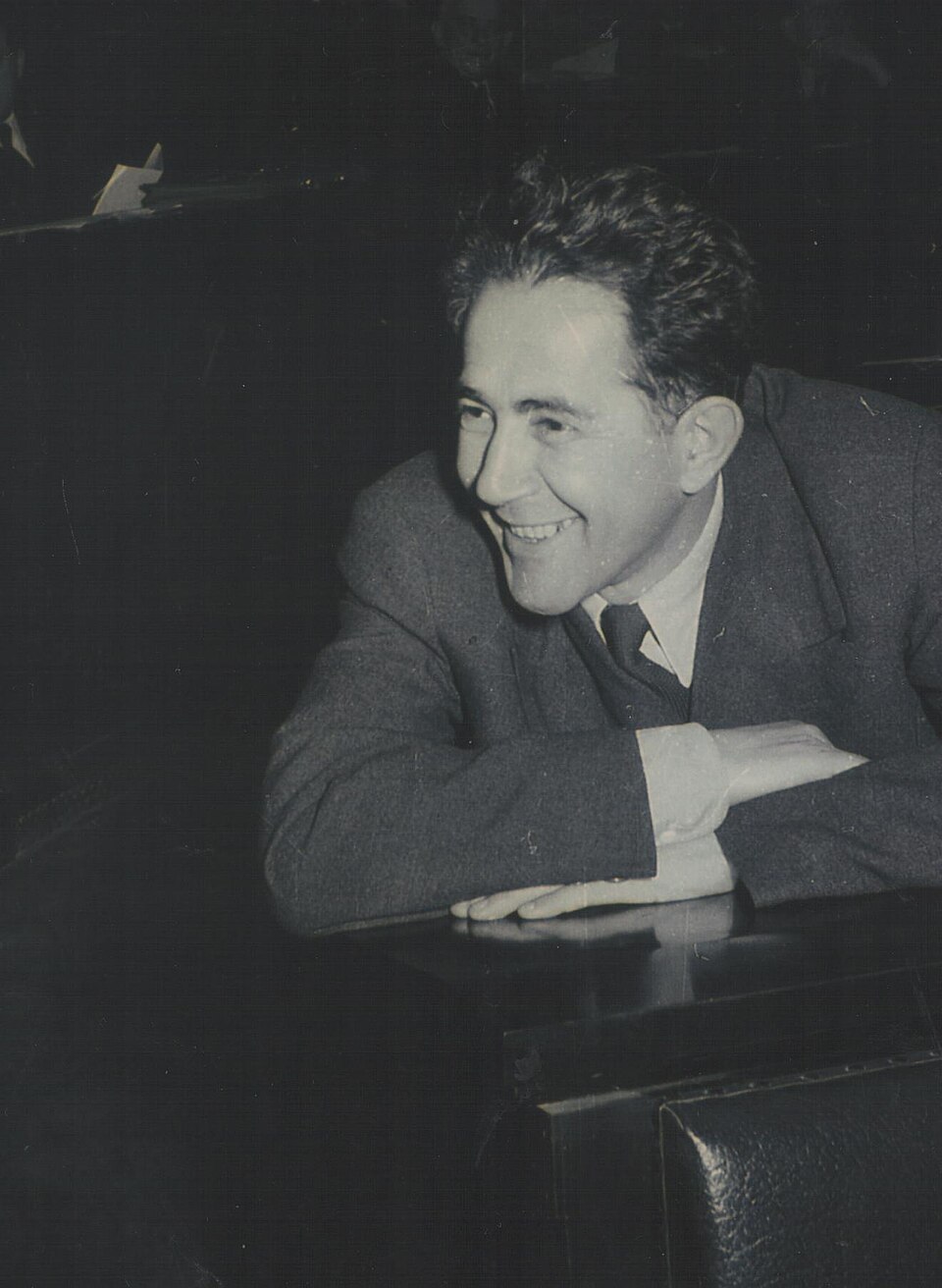
Milovan Djilas, former vice president of the Federal People's Republic of Yugoslavia
Where Soviet armies arrived, Stalin did not immediately impose one-party rule, the Soviet system, or planned economies. Instead, he established coalition governments. In every Eastern European state—most clearly Czechoslovakia, but also Poland, Hungary, and the Balkan countries—the presidents were bourgeois politicians, without exception.
He did the same in Asia. He made Mao Zedong fly to Chongqing to negotiate with Chiang Kai-shek, insisting: “You cannot fight a civil war; you must establish a coalition government.” The same applied in Korea. Vietnam was still an earlier-stage French matter in which the Soviet Union did not intervene.
Even in Western Europe, the three largest communist parties controlled major armed forces: five hundred thousand under the French Communist Party, 250,000 in the Italian Communist Party's “people's liberation army,” and one hundred thousand guerrillas under the Greek Communist Party. Stalin made them lay down their arms and enter government, forming multiparty electoral systems.
Because Stalin was already satisfied on security, he did not want trouble in these areas. He observed his commitments to the West and acted accordingly. On security, the Soviet Union would not proactively challenge the United States: it had neither the need nor the ability.
Under the international division among the Four Policemen, the United States and Soviet Union had almost no geopolitical overlap: one was in the Americas and the other in Europe and Asia, separated by the Atlantic and Pacific. Their overlap appeared in two unresolved or unsatisfactorily resolved questions: Japan and Germany.
The Soviet Union was somewhat dissatisfied over Japan but swallowed its resentment. The issue was the division at the thirty-eighth parallel. Moscow had hoped to land on Hokkaido, but Washington refused; the Soviets yielded and chose to participate in some policy design through the Far Eastern Commission.
The German question dragged on because of occupation zones, which we will discuss later. Yet even this was not simply a U.S.–Soviet contradiction. It was a disagreement over the occupation of Germany and how to handle the country after the war.
*This episode is excerpted from Shen Zhihua's June 2020 lecture “Economic Factors in the Origins of the U.S.–Soviet Cold War,” presented at the World History Summit Forum jointly organized by East China Normal University's Institute of World History and Daxia College. It was edited for audio, with minor cuts and added music.
Editor: Xiaochan
Preview ended. Subscribe to read the full article.