




To Your Unique Self: 40 Lessons in Personality Psychology

Hello, I’m Wang Fang. Time passes quickly: we have reached the final episode of Part One. Over the previous eight episodes, we examined how modern personality psychology understands and identifies differences between people, focusing on two models of personality traits:the Big Fiveandthe Dark Triad.。
We describe personality to understand ourselves and others, hoping to use someone’s traits to predict future behavior and perhaps even infer the direction of their life. A popular saying in China holds thatcharacter determines destiny, perhaps derived from the ancient Greek philosopher Heraclitus’s statement that character is fate. Do you agree?
Answering requires two premises. First,is personality stable?Second,can personality predict behavior?Let us examine them.
Personality Is Stable, but Traits Do Not Always Predict Behavior
Have you attended a class reunion recently—preferably one involving primary-school classmates lost for many years? Such gatherings may begin awkwardly because everyone needs time to warm up after so long apart. At first all remain reserved; after three drinks, their old selves reappear. “Oh! Same old formula, same familiar flavor. I’ve known them for twenty years, and they’re still just as unreliable!” This illustrates personality stability.
How stable is it? Consider a meta-analysis of 152 longitudinal personality studies reporting correlations across different ages (Roberts & DelVecchio, 2000). The studies followed participants from as little as one year to more than fifty, administering the same personality test before and after. Average consistency increased roughly linearly with age: a correlation of 0.50 from ages 3–21, 0.62 from 22–49, 0.76 from 50–59, and 0.73 from 60–73.
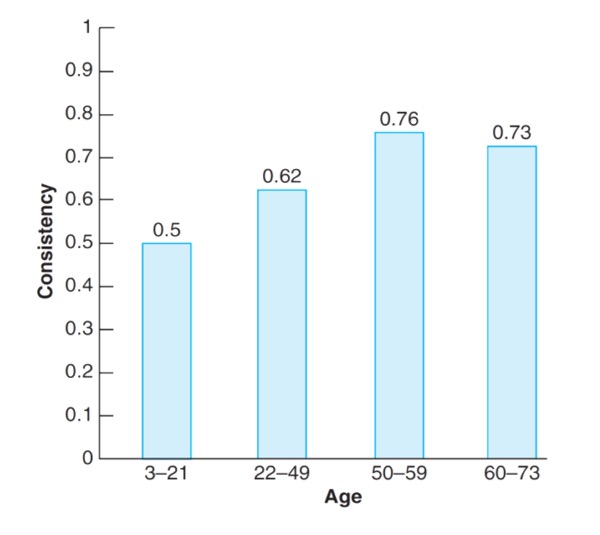
Retest Consistency of Personality Traits Across the Life Span (Roberts & DelVecchio, 2000)
In other words,overall, personality is most stable after age fifty.This is understandable. Developmentally, children are still forming their personality. Major life events are most concentrated in our twenties and thirties, and many cause small personality changes, so youth is less stable. Overall, however, personality remains relatively stable throughout life, and dramatic sudden transformations are rare.
2021.12.07
Audio in Chinese
Related programs

My Sexuality, My Own: Women’s Sexuality from the Beginning
Talk about sex naturally. Explore it healthily.
¥128.00
Included with membership

Ten Conversations with Hsu Cho-yun: Disease, Great-Power Rivalry, and Our Future
How will the world order change after a pandemic?
¥48.00
Included with membership

When Women Leave the Room: 20 Global Perspectives on Gender and Policy
Imagine a world in which women make the decisions
¥68.00
Included with membership