




Unconventional Relationships: Escape, Healing, and the Search for Love

【🤲🏻❤️: This bonus featureis bestpaired withthe mainepisode!】
Hello, everyone. I’m Xuemin.
This is the bonus feature for Episode 4 of Abnormal Relationships.
At the end ofEpisode 4, we discussed money and intimacy. Relationships are shaped not only by whether money exists, but by how we view and use it and what we invest in it—our money psychology.
Using The Great Gatsby, we continue exploring how our relationship with money affects intimacy.
Later I offer simple money-psychology tests. Try them alone or with a partner, friend, or family member; you may discover how differently each person relates to money.

The Great Gatsby (image: Douban)
Many people know The Great Gatsby and reduce it to a love story. To me,it is really about investing one’s self-worth in money, wealth, and family origin.
Fitzgerald’s novel, ranked second among one list of the twentieth century’s hundred best English-language novels, tells of a broken American dream in 1920s New York. It has been filmed several times; here I discuss the 2013 version starring Leonardo DiCaprio. I recommend watching it, though the story is probably familiar.
Observer Nick narrates. Poor young Gatsby loves wealthy Daisy but war and class divide them; she marries old-money Tom. Years later, Gatsby becomes rich, builds a mansion across the bay, and throws nightly parties to attract her. Their love revives and she considers eloping, but hesitates over his origins, wealth, and deceptions. Daisy accidentally kills Tom’s mistress in a car; Gatsby takes responsibility and is shot by the woman’s husband. Daisy and Tom return as if nothing happened to their glittering emptiness.
Did Gatsby love Daisy? Despite his effort and persistence, I think he did not love the real, whole Daisy. Two signs reveal this.
After becoming rich, he never tries to understand her five intervening years. Even after spending time together, he learns she has a child only through a conversation with someone else.
Nor does he support the life she wants. Daisy wants to run away and begin anew, but Gatsby insists on staying. She is a trophy used to proclaim his victory.
Perhaps he wants to love her well but lacks the capacity, trapped in inferiority and deprivation.He cannot see others in relationship; he watches only whether he himself is seen, respected, and loved, investing all of that in wealth.
Their first reunion seems romantic: Daisy says he has raided a flower shop. Yet Gatsby never asks Nick about her preferences; he constructs his own fantasy of a rich man’s romance.
In his mansion, he showers Daisy with shirts and she weeps. He could ask more, but when she says she has never seen such beautiful shirts, his vanity is satisfied and his concern stops.
Obsessed with whether his wealth overwhelms her, he never considers that privileged Daisy probably cries not for cloth but for an irrecoverable past and a future they may never reach.
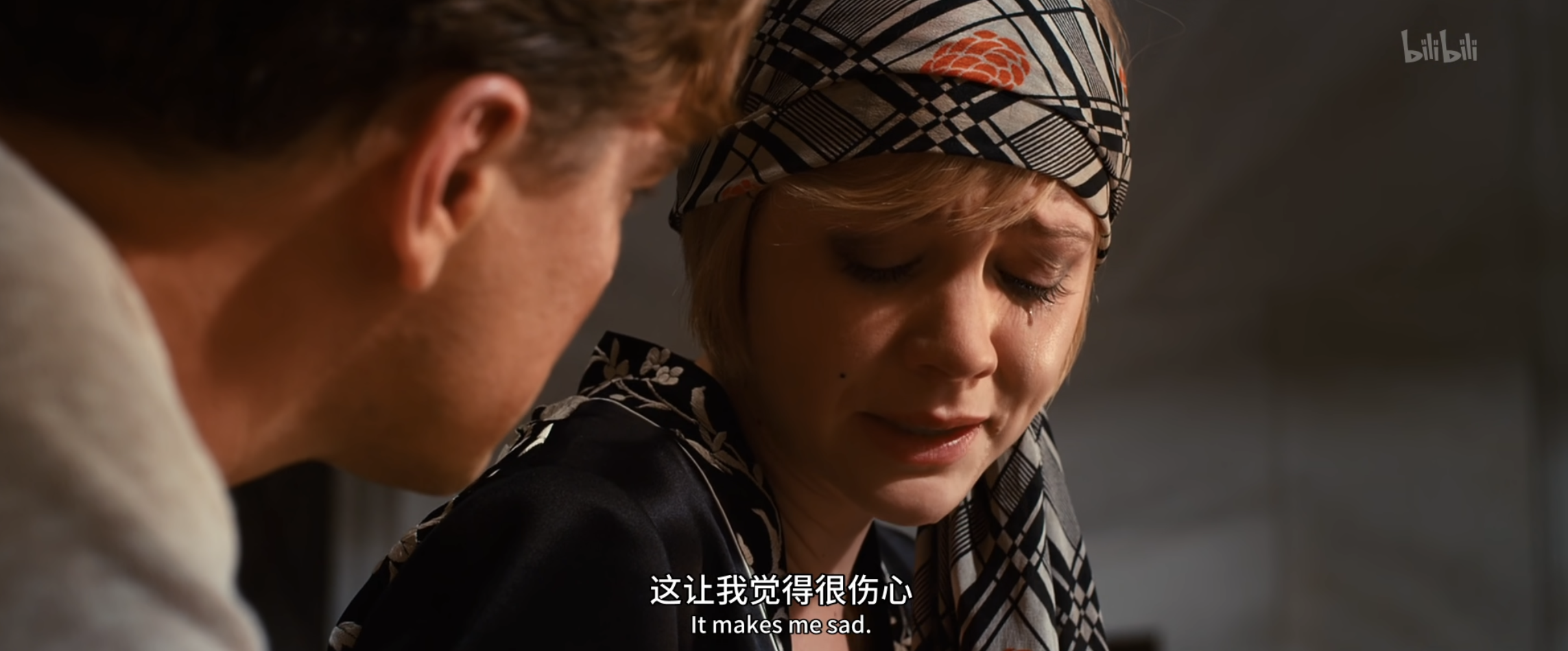
Daisy weeps amid the fabrics in Gatsby’s mansion (image: The Great Gatsby)
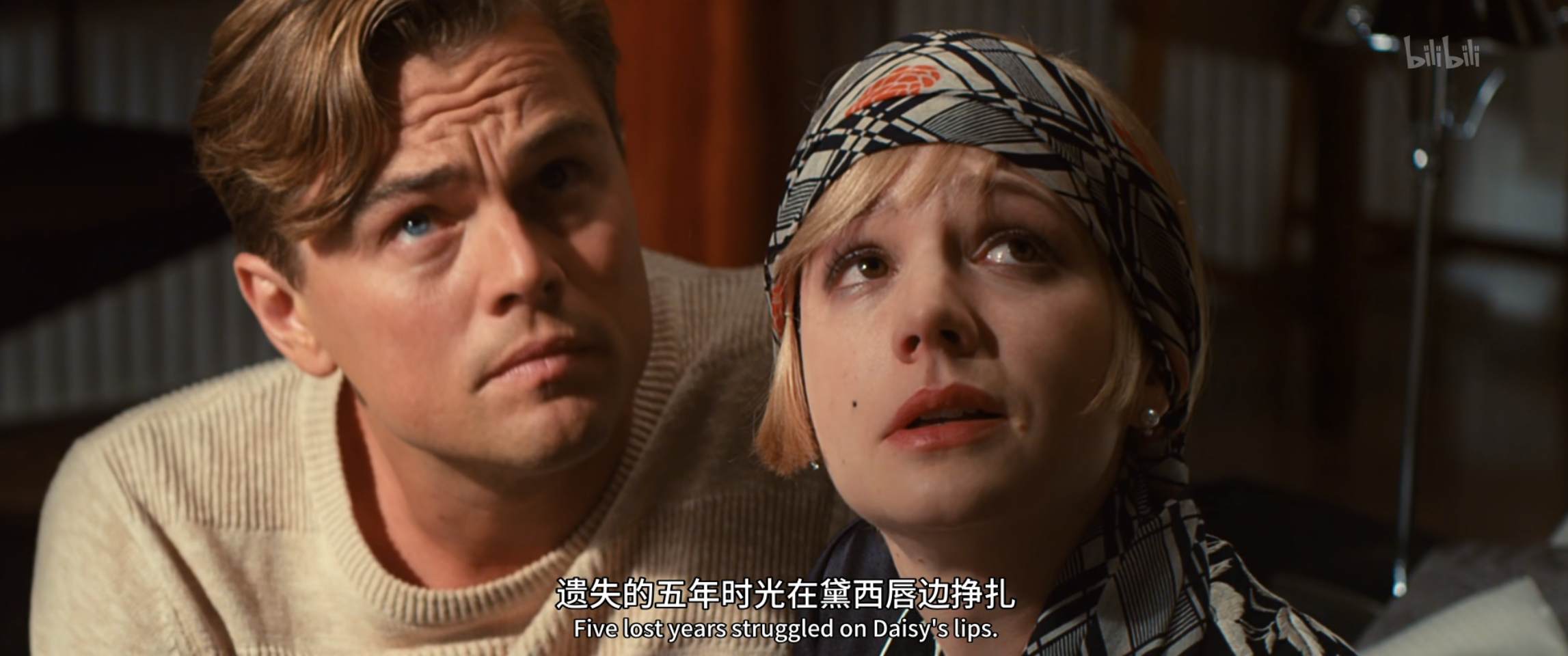
Daisy does not reveal the real reason, and Gatsby does not ask (image: The Great Gatsby)
At the Plaza Hotel, Gatsby confronts Tom and demands that Daisy tell him, “I never loved you.”
Is this really about love? No, it is about winning. Love allows complexity and change; Gatsby demands a Daisy who never left, changed, or loved anyone else.
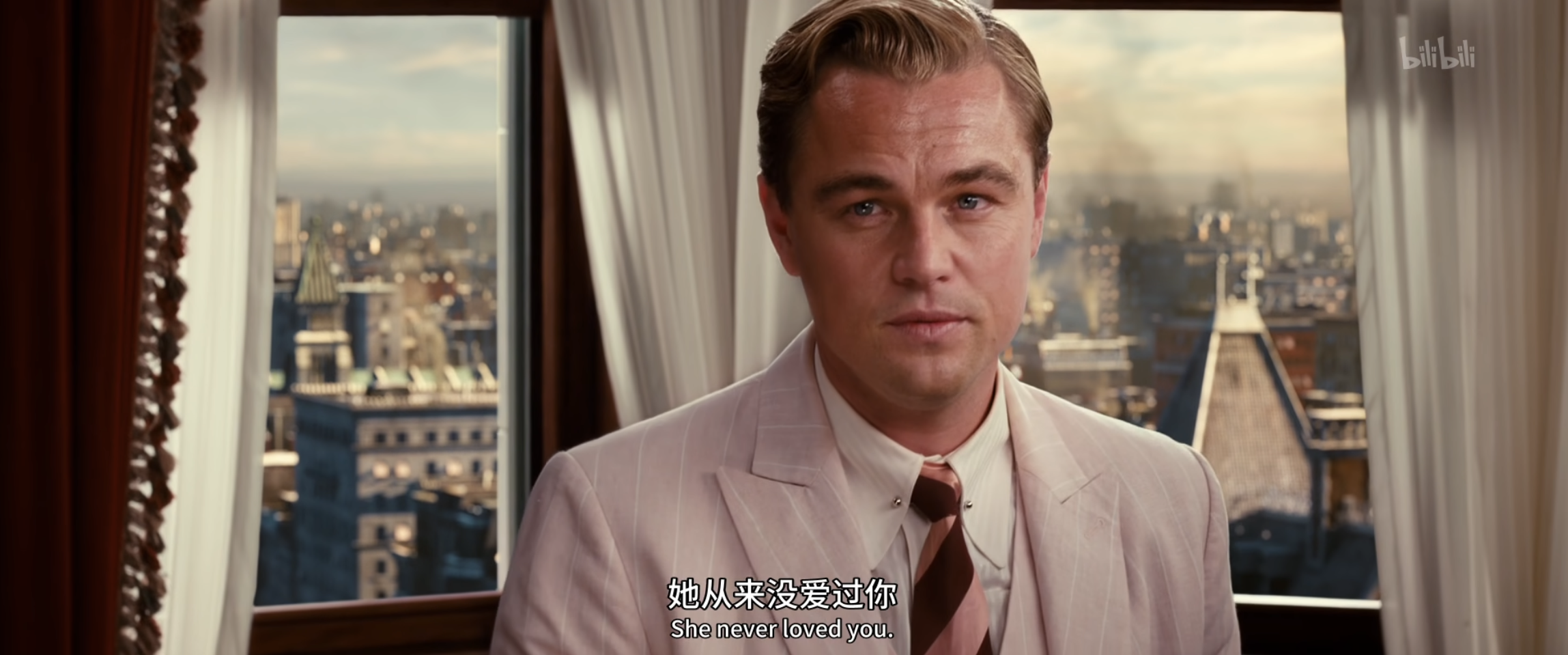
Gatsby tells Tom that Daisy never loved him and always loved Gatsby (image: The Great Gatsby)
There are no human beings in Gatsby’s heart—not Tom, Daisy, or even himself—only their symbols of wealth, origin, and victory.
“I never loved you” therefore means: however grand your origin, wealth, power, and resources, and though you possessed Daisy, you still lost to me. Even when I had no money, the trophy always belonged to me.
Gatsby is contradictory: he wins Daisy through wealth but denies its role; ashamed of humble poverty yet insisting that self deserved love. Seeking self-worth outside only proves wealth is his unbearable burden.
Moreover,when someone exaggerates and depends too heavily on wealth, the relational toolbox becomes impoverished. Listening, care, and companionship are used less, rust, and are forgotten.
Sometimes arrogance makes money easier than attention. At other times,money occupies all attention, hiding the many other forms of human connection.Money becomes the most practiced relational tool while genuine connection dwindles and disappears.
The ending is unsurprising. This money-built American dream—the glittering, roaring Jazz Age—must burst. Contradictory Gatsby cannot live in it, making his death inevitable.
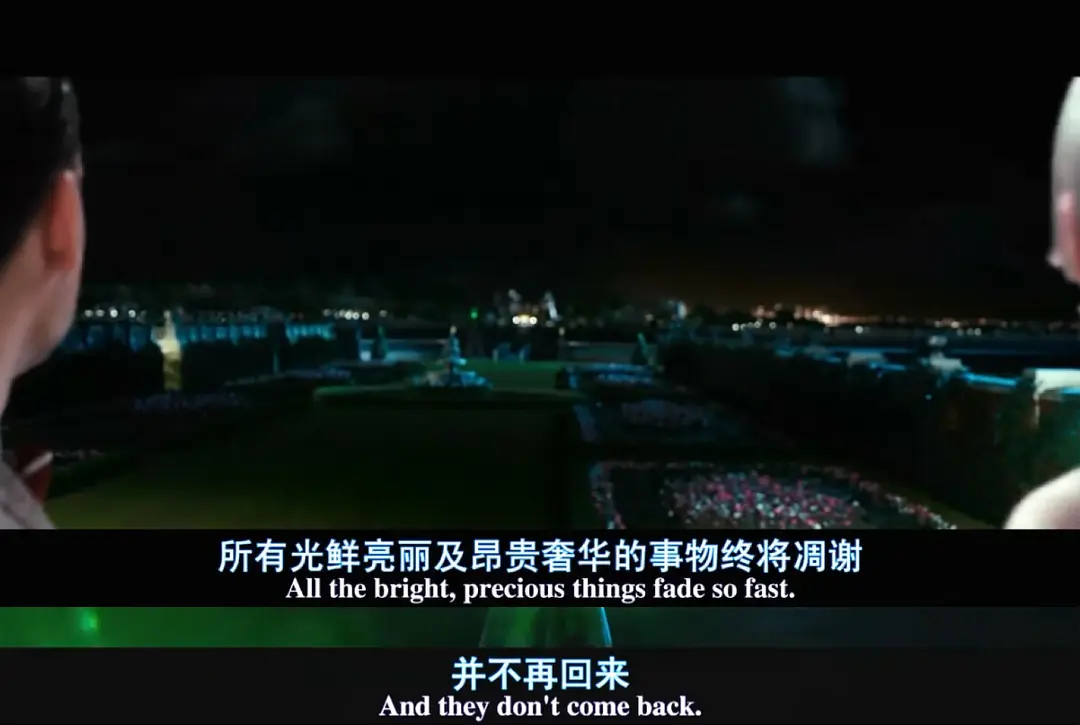
“All bright, precious things fade so fast, and they don’t come back” (image: The Great Gatsby)
Extremes like Gatsby are uncommon, but his problem is not his alone.
His true predicament is neither too little nor too much money, but making it the sole measure of self. He must use money to prove success, respectability, and lovability.When we entrust security, worth, dignity, or proof of love to money, we all become Gatsby in some degree.
That is why money psychology deserves attention. Its key questionis never merely how to spend or earn, but what money means and what we expect it to accomplish: security, control, independence, dignity, the capacity to love, or qualification to be loved.
Once money carries these functions, it enters every relational interaction.If we are psychologically unfree around money, its presence also makes intimacy unfree.Asthe main episodenoted, some cling to splitting every bill and ignore feelings and needs; others are constrained by the label “independent woman,” seeking formal monetary equality while ignoring the uniqueness of people and relationships.
Whether loving two people or oneself, money psychology must be valued and cultivated.
If you wonder about your own or another’s money psychology, complete these sentences. There are no standard answers; yours often reveals both your relationship with money and patterns in intimacy.
Money means ______ to me.
Rich people are usually ______.
My parents believe money is ______.
If I had more money, I would ______.
People are poor because ______.
When I spend money, I feel ______.
Asking someone for money makes me feel ______.
If I suddenly became rich, the worst thing would be ______.
In my circle, talking about money is ______.
That ends this short test; a fuller version appears in the manuscript.
As our money psychology gains agency, money can give us confidence. Yet I believeour deepest confidence finally comes from love—whether received from others or given to ourselves.
In Cry Me a Sad River, bullied nearly to collapse for seeking treatment for an STI, Yi Yao lifts her head after her mother takes her hand and accompanies her to the doctor.
We see thatwhen love is sufficient, people grow strength.When it is lacking, we seek confidence in money, appearance, education, identity, or status. These resources may bring power and create room for the self to survive and develop.
But resources and power do not automatically free us. Will we remain lost and defined by them like Gatsby, or master ourselves and learn to use them without being used?That largely depends on a strong, stable self and the relationships we build with money and other resources.
To strengthen your money psychology, besides Abnormal Relationships I recommend The Psychology of Money and Financial Issues in Counseling. May you have money, love, and the life you desire.
Appendix
Typical sentence completions based on money-psychology theory
I. Root beliefs about money
1. Money means ______ to me.
2. Rich people are usually ______.
3. My parents believe money is ______.
4. If I had more money, I would ______.
5. People are poor because ______.
II. Money and self-worth
1. The ability to earn determines whether a person is ______.
2. I do not deserve wealth because ______.
3. When I spend money, I feel ______.
4. Asking others for money makes me feel ______.
5. My worth depends on my savings because ______.
III. Money and relationships
1. Money ruins relationships because ______.
2. If I earn more than my friends, they will ______.
3. Lending money to family is ______.
4. Talking about money hurts feelings, so ______.
5. When my partner controls money, I feel ______.
IV. Money and fear or limitation
1. I can never become rich because ______.
2. I save to prevent ______.
3. Investing is dangerous because ______.
4. If I suddenly became rich, the worst thing would be ______.
5. The main pressure money creates is ______.
V. Money and behavioral patterns
1. I always run out by month’s end because ______.
2. I buy impulsively because ______.
3. I refuse financial planning because ______.
4. My money habits exactly resemble ______ (parents/society).
5. I am always saving for ______ but never achieve it.
VI. Further exploration: cultural and social influence
1. Society tells us success = ______.
2. In my circle, talking about money is ______.
3. Religion/culture teaches me money is ______.
4. If I were financially free, others would think I ______.
5. My greatest lie about money is ______.
How to use the sentences
1. Complete quickly: write the first response without rational polishing.
2. Find patterns: repeated words such as “fear,” “undeserving,” or “danger” reveal possible scripts.
3. Classify: limiting scripts such as “money is dirty”; avoidance such as “I don’t need money”; over-pursuit such as “money equals happiness.”
Theoretical background
In transactional analysis, Claude Steiner proposed that money scripts form part of childhood “life scripts.” Brad Klontz later divided them into four types: money avoidance, money worship, money status, and money vigilance.
2026.06.08
Audio in Chinese
Related programs

When Love Ends: The Infinite Life Reading List, Season 18
What Is Left to Say About Love?
¥48.00
Included with membership

Love and Fear: The Dilemmas and Possibilities of Marriage Today
How can we reimagine intimate relationships?
¥98.00
Included with membership

Love and Pain: 30 Attempts to Break Free from Hurt
Move beyond instinct and understand harm committed in the name of love
¥128.00
Included with membership